(Dr. Mercola) While Whole Foods Market, founded in 1980, has been a leading retailer of organic produce in the U.S. for decades, the company has faced its share of criticism; in later years being accused of operating more like an industrial organic company rather than a local distributor of high-quality organic food.
In 2007, it bought its chief rival Wild Oats — an acquisition initially challenged by the Federal Trade Commission, which said the merger violated federal antitrust laws and provided Whole Foods unilateral market power that could raise prices and lower quality. The issue was eventually settled by selling off the Wild Oats brand and more than 30 physical store locations.1,2
Amazon Now Owns Whole Foods
Last year, Amazon announced its intention to acquire Whole Foods Market and its 465 stores, a $13.7 billion deal that had food manufacturers quaking in their boots, while organic producers worried the deal might compromise and dilute organic food standards even further.3 The acquisition went through on August 28, 2017.4 Within two days of the merger, Whole Foods’ store traffic rose by 25 percent. Within the first month, Amazon made $1.6 million off its online sales of Whole Foods private label products.
Related: How to Avoid GMOs in 2018 – And Everything Else You Should Know About Genetic Engineering
But while the success story of Whole Foods continues, questions about whether it’s really socially commendable to shop at Whole Foods have festered well over a decade.5 The company has faced well-deserved criticism for its effects on employees by refusing unionization, the environment due to its limited supply of local produce, and its selling of questionable products such as items containing MSG and rBGH, making label scrutiny a necessity even here.
Like most large corporations, it has shareholders to contend with, and the company has been accused of cutting corners to make a profit on more than one occasion. This trend is unlikely to change with Amazon at the rudder. As a matter of fact, while Whole Foods has spent the last five years promoting its promise to implement a comprehensive labeling policy6 for genetically modified organisms(GMOs) — a promise that has been a major selling point to entice customer support — that plan has now been laid aside.
Whole Foods Reneges Its Promise to Implement GMO Labeling
As reported by New Food Economy,7 Whole Foods’ GMO labeling policy was scheduled to take effect September 1, 2018. However, in a May 18 email, Whole Foods president and CEO A.C. Gallo announced the company’s labeling requirement is being “paused” in response to concerns from suppliers about having to comply with both Whole Foods’ rules and those proposed by the U.S. Department of Agriculture (USDA). The public comment8 period ended July 3 and the final rule is expected to be delivered July 29.
“As the USDA finalizes the federal regulation in the coming months and the food industry assesses the impact, we do not want our Policy to pose further challenges for you and your business,” Gallo writes. As reported by New Food Economy:
“As currently proposed, the USDA policy would make several substantive changes to the way GMOs have traditionally been defined by the food industry — starting with the terminology itself. The government’s preferred nomenclature is “bioengineered” (BE), which only refers to a food that has had another organism’s genes spliced into it by a process called transgenesis.
Other types of genetic modification, including some produced by gene-editing tools like CRISPR, would not need to be labeled. As currently written, Whole Foods’ requirements would be more stringent than the proposed USDA rules in at least two significant ways.
First, USDA has suggested letting companies label BE ingredients by QR code, meaning that customers would need to be directed to a website via smartphone to find out what’s in their food … Whole Foods has never planned to allow QR codes to count as GMO disclosures …
Second, USDA rules contain perplexing carveouts for meat products, which are regulated under a different system9,10 … Whole Foods now faces a choice: It can move forward with its original plan, or defer to the government’s less comprehensive new rules.”
Is Whole Foods Committing Fraud?
As noted by New Food Economy, “All this begs a question: Is Whole Foods softening its commitment to GMO-labeling transparency?” The company promised its customers it would lead the way by labeling food sold in its stores in a clear and transparent manner. In fact, it was the first national grocery chain to make such a commitment, and many have patiently waited for the implementation of this promise, as it would set a new, higher standard for others to follow.
Related: Best Supplements To Kill Candida and Everything Else You Ever Wanted To Know About Fungal Infections
Transparent GMO labeling is also what more than 8 in 10 Americans want.11 If Whole Foods ends up adopting USDA rules, many GMO-containing foods will remain unlabeled, which is nothing short of unacceptable, especially for a company that claims to be a leader among organics. As noted in the featured article, “It would mean that a company that’s long claimed the moral high ground would be no more transparent, as far as GMO labeling goes, than any other grocery store.”
Whole Foods assured New Food Economy that it remains “committed to providing our customers with the level of transparency they want and expect from us and will continue to require suppliers to obtain third-party verification for non-GMO claims.” But if that’s the case, why has no new deadline for its GMO labeling been announced?
March 8, 2013, Whole Foods issued a statement saying, “by 2018, all products in its U.S. and Canadian stores12 must be labeled to indicate if they contain GMOs. Whole Foods Market is the first national grocery chain to set a deadline for full GMO transparency. ‘We are putting a stake in the ground on GMO labeling to support the consumer’s right to know,’ said Walter Robb, co-CEO of Whole Foods Market.”
To me, it seems incredibly disingenuous to mislead and lie to customers for five years with a promise to be the first to really do the right thing, and then not follow through just because the government is working on rules that in no way, shape or form fulfill customers’ expectations of transparent labeling. It is my sincere hope that some of you will be angered enough to file a class-action lawsuit against them for this injustice.
Recommended: Sugar Leads to Depression – World’s First Trial Proves Gut and Brain are Linked (Protocol Included)
USDA Bioengineered Labeling Is a Joke
The U.S. Department of Agriculture (USDA) released its proposal13 for the labeling of foods containing GMOs May 3 — a bizarre, or to use the word of Sierra Club, “Orwellian,” rule that appears to misdirect and create unnecessary confusion on purpose. Perhaps most problematic is the fact that it’s not clear whether “highly refined foods” will be included in the standard. Not only are a majority of foods sold in grocery stores highly refined, or contain highly refined ingredients, but these foods are also the most likely to contain GMOs.
If highly refined foods will not require GMO labeling, the labeling requirement will be essentially useless, as very few whole foods are genetically engineered. Another significant problem is the absence of the phrases “genetically modified” or “genetically engineered” on the label. Not even the now well-recognized household word “GMO” is to be found anywhere on the USDA’s GMO label. Instead of calling it what it is, and what people now are most likely to understand, the USDA is using the word “bioengineered” or BE for short.
This is a misleading phrase for the simple fact that it sounds far more natural than it is; closer to biodynamic than genetically modified. The proposal also does not address whether foods produced using newer forms of genetic engineering, such as gene editing, CRISPR technology and synthetic biology, will need to be labeled, and/or whether they would require another type of label to distinguish them from in-vitro DNA techniques.
Adding insult to injury, the logo itself is clearly designed to impart a false impression of GMOs as being natural and wholesome. The proposed logo (two versions of which are included here), is the word “be” inside a smiley-face sun. The whole thing smacks of biotech promotion and misdirection. As stated by George Kimbrell, legal director for the Center for Food Safety, “We would support a little circle that said ‘GE’ or ‘GMO’ — something neutral that’s not pro-biotech propaganda.”
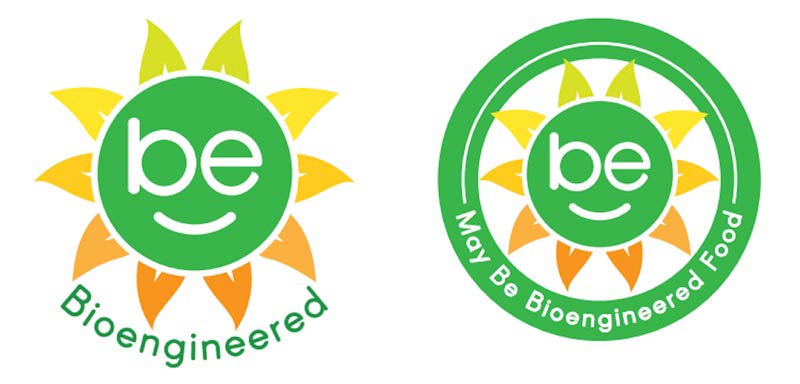
Last but not least, the proposed rule does not even include the requirement to use a standardized icon. Rather than mandating an easily recognizable icon or logo, companies would have the option of using:
- The smiley sun logo (above)
- Two other “BE” logos (see the proposed rule document14
- Adding a sentence along the lines of “Contains a bioengineered food ingredient” without logo
•Simply including a QR code directing you to the company’s website for more information about the ingredients, which will require you to have a smartphone and reliable connection inside the store, something which one-third of Americans don’t have.
As a result, the use of QR codes has been criticized as being inherently discriminatory against rural, low-income and elderly populations.15 Internet and smartphone availability really should not be a criterion for getting information about what’s in the food you’re holding in your hand and contemplating buying
Why Rename What Everyone Already Knows?
A solid decade has been spent educating Americans about genetically engineered (GE) foods and foods containing GMO ingredients — what they are and that they exist in the first place. With this in mind, the USDA’s decision to ditch the terms GE and GMO and replace them with BE seems extremely suspect.
As noted by Sophia Kruszewski, senior policy specialist with the National Sustainable Agriculture Coalition, the timing is even more suspect “since many companies have responded to consumer desire for transparency and started voluntarily labeling their products. [GMO disclosure] doesn’t seem to pose an enormous challenge.”16
The only reason I can come up with for unnecessarily complicating matters is that the USDA is assisting the biotech industry by making the labeling as obscure as possible. And, if Whole Foods decides to just follow along with this opaque and nonsensical strategy, it stands to lose consumers’ respect, not to mention trust.
The Great GMO Escape
In related news, “missteps by agribusiness giants” have allowed invasive GE grass developed for golf courses to spread across Jefferson and Malheur counties in Oregon.17 The creeping bentgrass developed by Scotts Miracle-Gro and Monsanto a decade ago was engineered to withstand Roundup application, which would be a boon for keeping golf courses pristine and clear of weeds.
The grass was never approved by the USDA. Alas, it spread from old seed fields into areas it doesn’t belong — a perfect example of why GMO test plots should not be allowed outdoors, and why farmers really should have the right to sue companies for contaminating their fields with GE seeds, and not the other way around. (Historically, farmers found growing GE crops without having purchased seed are the ones who have been getting sued for patent infringement).
Some 80 acres of the GE bentgrass was planted in Canyon County, Idaho, and another 420 acres in Jefferson County, Oregon. In late summer 2013, two storms swept through Oregon, scattering the seeds “well beyond the designated control area.” Since then, the grass has become part of the natural environment, with virtually no possibility of getting rid of it. According to High Country News, the grass “thrives in canals and ditches, where it collects sediment and impedes water flow.”
The fact that it’s so hard to kill has become “a headache” for farmers who are already battling a number of other weed problems, and many fear the GE grass will eventually migrate into Willamette Valley, where many of the primary grass businesses in Oregon are located. Don Herb, a seed dealer in Linn County, told Oregon Live,18 “That would be a catastrophic event for Oregon’s grass seed industry. We don’t need Scotts and others to put our industry at risk.”
Scotts was fined $500,000 in 2007 for allowing the grass seeds from its test plots to escape, and the company has reportedly tried to rein in the spread of its unapproved grass but, now, the company will no longer be held liable. “[I]n a series of decisions over the last several years, the USDA has relieved Scotts of future responsibility in return for the company’s promise not to market the grass,” High Country News writes.
This hardly seems like a fair deal, considering estimates suggest it’s costing as much as $250,000 annually to keep up with its removal. Who will pay that bill? State, county government and local growers, most likely. What’s worse, the GE bentgrass also has the potential to impact national forests and grasslands, which would further add to the financial burden caused by Scotts and Monsanto’s carelessness.
Will You Remain Loyal to Whole Foods or Let Them Know How You Feel About Their Deception?
There are many problems associated with GMOs, from environmental problems to human health risks. As such, it’s really imperative for consumers to be fully informed about what they’re buying, especially when it comes to their food. Whether Whole Foods will fulfill its promise to lead the way by requiring GMO foods sold in its stores to be clearly labeled remains to be seen.
At present, it seems to have decided that making it easy for suppliers is more important than fulfilling its promise for labeling to its customers. If you’re a frequent shopper at Whole Foods, you may want to share your views with the company’s leadership. You can find company contact information on the Whole Foods Market customer service page.19