Studies Link Heavy Metals To Explosion Of Neurodevelopment Disorders And Declining IQ In Children

(Natural Blaze) A “silent pandemic of neurodevelopmental toxicity” is disabling a generation of children around the world. This is the verdict of neurology experts Philippe Grandjean and Philip Landrigan in a 2014 report in Lancet Neurology. The staggering tsunami of developmental disabilities now affects at least one in six children in the U.S. and millions more worldwide. Two new studies suggest that the most common of these illnesses—autism spectrum disorder (ASD), attention-deficit hyperactivity disorder (ADHD) and tics—are related to each other and may share common causation. The culprit? Environmental toxins, particularly heavy metals.

About 11% (or one in nine 4-17-year-olds) have received an ADHD diagnosis—and in some states, as many as 19%. The most recent ASD estimates in the U.S., from 2014 data, report a prevalence of one in 45 children, representing a “significant increase” compared to 2011–2013.

Adding to the worry, scientists and physicians are increasingly seeing children with multiple neurodevelopmental disorders. Children with “comorbid diagnoses” (i.e., more than one disorder) often have “greater levels of emotional, behavioral and educational impairment and the need for more intensive treatment.” Notably, ASD and ADHD frequently co-occur. The current version of the Diagnostic and Statistical Manual of Mental Disorders (DSM-V) recognizes this trend by allowing for a combined diagnosis, whereas prior versions (DSM-IV and DSM-IV-TR) barred simultaneous ADHD and ASD diagnoses.

Related: Detoxify and Heal From Vaccinations – For Adults and Children

Neurodevelopmental disorders overlap even in the general population

A new UK-based study in the Journal of Attention Disordersexplores undiagnosed ADHD and ASD in a population of mostly female adult volunteers drawn from the general population. The researchers included only participants who had never received a diagnosis of ADHD, ASD, dyslexia or another mental disorder. Participants completed four online questionnaires that measured ADHD and ASD traits.

  • The researchers classified one-fifth (20%) of the participants as having ADHD despite their lack of a prior diagnosis.
  • A substantial proportion (4.3%) of undiagnosed participants also had a score indicative of at least mild autism.
  • The investigators noted considerable overlap between ADHD and ASD traits, particularly for pragmatic language(“knowing what to say, how to say it, when to say it, and generally how to ‘act’ around others during conversation”) and for attention-related skills.
  • An intriguing correlation between seemingly contradictory measures of distractibility (ADHD) and hyperfocus (ASD) prompted the researchers to speculate that “these two extreme manifestations of attention deficits could be controlled by the same mechanism.”

Comorbidities abound

A new Canadian study in the International Review of Neurobiology also found an overlap in neurodevelopmental disorders. The study’s authors note that 85% to 90% of patients with Tourette syndrome and other tic disorders have comorbidities and manifest an overlapping spectrum of “sensory-, behavioral-, cognitive- and sleep-related problems that have a major impact on their functioning and quality of life.” These comorbidities commonly include ADHD, ASD, obsessive-compulsive disorder (OCD) and mood and anxiety disorders. These data support prior studies showing that the rate of Tourette syndrome in autistic children is almost seven times higher (6.5%) than the rate for children drawn from the general population (0.95%).

…share a “common mechanism and represent a comorbid condition” that links nervous system injuries to immune system damage.

Many other studies of comorbidities have suggested that ADHD is comorbid with a wide range of other neurodevelopmental and psychiatric disorders, including dyslexiadepressionoppositional defiant disorder and eating disorders. One group of researchers has even postulated that ADHD and allergic rhinitis share a “common mechanism and represent a comorbid condition” that links nervous system injuries to immune system damage. This suggests that perhaps a single toxic culprit may be causing both kinds of damage simultaneously. All of these studies raise the question of whether these concurrent disorders represent a “neurodevelopmental continuum” that “transcends traditional diagnostic boundaries.”

Related: Increase your IQ with the Right Foods, Herbs, Vitamins, and Exercises for Your Brain

Multiple metals

Multiple studies have pointed to heavy metals as the leading culprit in the cascade of neurodevelopmental disorders. Moreover, the effects of heavy metals on cognition and behavior are synergistic: “Co-exposure to multiple metals can result in increased neurotoxicity compared to single-metal exposure, in particular during early life.” Research indicates, for example, that ADHD and problems such as sleep disturbances are more prevalent in children who live near coal ash (which contains metals such as leadmercury and arsenic); childrenwith ASD have significantly higher blood levels of arsenic and mercury compared to healthy controls; and autistic children have higher levels of mercurylead and aluminum in their hair compared to matched controls.

…environmental toxins are causing widespread brain injury and loss of function across a generation of children.

Where are we headed?

Grandjean and Landrigan believe that environmental toxins are causing widespread brain injury and loss of function across a generation of children. The broad decline in neurological function is not captured by the increasing diagnoses of discrete neurodevelopmental disorders; the UK study of ADHD and ASD seems to bear this out, detecting overlapping ADHD and ASD symptoms in 20% and 4.3%, respectively, of its sample of undiagnosed adults.

This finding suggests that widespread brain damage may be affecting an entire generation without anyone taking official notice. Those indications are supported by the explosion in special education clinics in schools across western nations.

Related: How Candida Leads to Depression, Anxiety, ADHD, and Other Mental Disorders

Referring to the epidemic in childhood brain disorders, Harvard researcher David Bellinger has noted the urgency of paying more attention to “subclinical effects.” For example, many environmental toxins decrease IQ.

Bellinger states, “Even a modest impact that does not push a child’s neurodevelopment into the range of clinical concern cannot be dismissed as benign because, if the exposure is prevalent, the total number of IQ points lost in the population as a whole might be large, and the reduction in the intellectual resources available to a society substantial.” Citing Bellinger’s work, a group of Oregon researchers reports that a 5-point decrease in mean IQ would increase the cognitively impaired population by 57%.

Far from being “little adults,” children are uniquely vulnerable to environmental toxins. Not only is the human brain “exquisitely sensitive to the impacts of environmental toxicant exposures during development,” but it “can serve as ‘the canary in the coal mine’ for such exposures.” Yet even though U.S. children’s catastrophic state of health and neurodevelopment is emblazoned across virtually every set of child health statistics, public health and regulatory agencies continue to turn a blind eye.

Scientists Discover Frightening Amount Of Plastic Fibers In Drinking Water Environment

(True Activist) Researchers all over the world are discovering micro plastic particles in drinking water. Studies from a dozen countries reported plastic fibers in 83% of tap water samples. The United States had the highest number of contaminated samples, with 94% showing the presence of plastic particles.

“Microplastics have been shown to absorb toxic chemicals linked to cancer and other illnesses, and then release them when consumed by fish and mammals,” said Orb Media. Plastic is beyond ubiquitous, and furthermore, it can never biodegrade, it can only be broken down into smaller and smaller pieces.

How plastic gets into the air, water and food is frightening and unavoidable. Car tires release plastic particles during abrasion, synthetic fabrics shed thousands of particles in the washer and dryer, among countless other sources.

These plastics can attract bacteria and become carriers of diseases. According to Dr. Anne Marie Mahon at the Galway-Mayo Institute of Technology, “Some studies have shown there are more harmful pathogens on micro plastics downstream of wastewater treatment plants.”

Water treatment systems cannot filter out all plastic fibers because they are so small.

These nanoparticles of plastic have been shown to travel through the walls of the intestine, ending up in the lymph nodes, lungs, and other organs. Plastic was also found in samples of commercially bottled water in the United States, as well as bottled beer in Germany.

“We are increasingly smothering ecosystems in plastic and I am very worried that there may be all kinds of unintended, adverse consequences that we will only find out about once it is too late,” said Prof Roland Geyer, from the University of California in Santa Barbara, reporting that 300m tonnes of plastic are produced annually and only 20% is recycled or incinerated.

Related Reading:

Antidepressant Use Continues To Rise Sharply Especially Among Children

Mental health in America is in decline, and while there is no one-size-fits-all reason for this, doctors and psychiatrists do offer a

one-size-fits-all solution: antidepressants. The number of people who have taken antidepressants has soared some 65% in just the last 15 years, and the numbers continue to rise.

new survey from the U.S. Centers for Disease Control and Prevention (CDC) offers insight into how this usage breaks down in our society. The most recent data reveals the following conclusions:

According to the latest statistics,9,10,11,12 use of antidepressants in the U.S. rose by 65 percent between 1999 and 2014. As of 2014:

Nearly 1 in 8 Americans (13 percent) over the age of 12 reported being on antidepressant medication

1 in 6 women (16.5 percent) reported antidepressant use compared to 1 in 11 men (9 percent)

About one-quarter of those who had taken an antidepressant in the past month reported being on them for 10 years or more

Caucasians were more than three times more likely to use antidepressants than Blacks, Hispanics or Asians (16.5 percent compared to 5.6 percent, 5 percent and 3.3 percent respectively)

In Scotland, researchers also warn that antidepressant use among children under the age of 12 has risen dramatically.13 Between 2009 and 2016, use in this age group quadrupled. Use among children under 18 doubled in the same time frame. [Source]

The Organization for Economic Cooperation and Development (OECD) examined data in 25 countries to determine who uses the most antidepressants, revealing some interesting details. For example, in some countries, usage is also spiking, and of note is the fact that numbers are increasing among children and young adults as well.

In Germany, antidepressant use had risen 46% in just four years. In Spain and Portugal, it rose about 20% during the same period. Iceland led the pack in overall use with about one in ten people taking a daily antidepressant — but that figure may underestimate the actual rate of use, since that calculation isn’t restricted to just adults. [Source]

The United States leads the world in the consumption of antidepressants, followed closely by Iceland.

In the United Kingdom, antidepressants prescribed to children soared a staggering 50% in recent years, highlighting a growing trend.

In the period examined, there was a 54% increase in the number of young people prescribed anti-depressants in the UK.

This is compared with rises of 60% in Denmark, 49 per cent in Germany and just 26 per cent in the US and 17 per cent in the Netherlands, the BBC said. [Source]

Some of the factors that may be contributing to such a dramatic rise are the fact that seeking help for mental health conditions is more socially acceptable, people are more stressed than ever, social media creates an environment of envy, direct manufacturer to consumer marketing of pharmaceuticals, and an increased willingness by physicians to experiment with antidepressants as a remedy for many conditions other than strictly depression.

Related: Serotonin, What You Need to Know About the Body’s Key to Health and Happiness

There are many alternatives to taking antidepressants many of which involve lifestyle changes which are often much more difficult for people to achieve, especially when we’ve been trained to depend on pills as a simple solution for anything that ails us. Some even look at depression as a sickness in spiritual health, although this type of information is unlikely to be offered by typical physicians.

Read more articles by Alex Pietrowski.

Alex Pietrowski is an artist and writer concerned with preserving good health and the basic freedom to enjoy a healthy lifestyle. He is a staff writer for WakingTimes.com. Alex is an avid student of Yoga and life.

This article (Antidepressant Use Continues to Rise Sharply Especially Among Children) was originally created and published by Waking Times and is published here under a Creative Commons license with attribution to Alex Pietrowski and WakingTimes.com. It may be re-posted freely with proper attribution, author bio, and this copyright statement.

Walnuts Light Up Brain Region That Controls Appetite

Walnut kernels and whole walnuts on rustic old wooden table

(Natural Blaze by Heather Callaghan) Unique study reveals documented mechanism of just a few walnuts to decrease hunger signals

A recent two- or three-part double-blind study demonstrated that less than half a cup walnuts (0.44 cup or 48 grams to be exact) per day made a significant difference in hunger levels on obese, post-menopausal women. But the study didn’t stop there…

Related Reading: The Rocky Road to Menopause and How Essential Oils Can Help

First…from Science Daily:

The scientists recruited 10 volunteers with obesity to live in BIDMC’s Clinical Research Center (CRC) for two five-day sessions. The controlled environment of the CRC allowed the researchers to keep tabs on the volunteers’ exact nutritional intake, rather than depend on volunteers’ often unreliable food records — a drawback to many observational nutrition studies.

During one five-day session, volunteers consumed daily smoothies containing 48 grams of walnuts…

[…]During their other stay in the CRC, they received a walnut-free but nutritionally comparable placebo smoothie, flavored to taste exactly the same as the walnut-containing smoothie. The order of the two sessions was random, meaning some participants would consume the walnuts first and others would consume the placebo first. Neither the volunteers nor the researchers knew during which session they consumed the nutty smoothie.

As in previous observational studies, participants reported feeling less hungry during the week they consumed walnut-containing smoothies than during the week they were given the placebo smoothies.

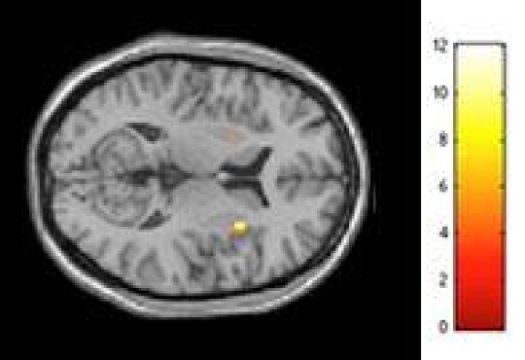
The fMRI scans are what make this study truly unique… Although this was a small study on just a few women, the brain scans can tell no lies…

While in the machine, study participants were shown images of desirable foods like hamburgers and desserts, neutral objects like flowers and rocks, and less desirable foods like vegetables.

When participants were shown pictures of highly desirable foods, fMRI imaging revealed increased activity in a part of the brain called the right insula after participants had consumed the five-day walnut-rich diet compared to when they had not.

“This is a powerful measure,” said Dr. Christos Mantzoros. “We know there’s no ambiguity in terms of study results. When participants eat walnuts, this part of their brain lights up, and we know that’s connected with what they are telling us about feeling less hungry or more full.”

They think the insula might be involved in cognitive control and salience. Weirdly, they think the region lighting up means that participants were selecting the “less desirable” or healthier options over the more visibly appealing or “junky” foods. Could walnuts help or reset a taste for healthier foods? Only time will tell…

Walnuts are a brain food that has fats that are ideal for a woman’s reproductive system. They contain omega-3 fats like Alpha-lipoic Acid, for instance, that our bodies can potentially convert to DHA and EPA fats.

Related Reading: Gonads – Reproductive Health – Natural Endocrine Health

Some people are sensitive to fats and may wish to limit their consumption to 1-2 ounces of nuts like walnuts. Some people start eating them and cannot stop! But if walnuts can play a role in controlling the factors of obesity like appetite control, then a dietary solution to a dietary problem is an ideal one to consider.

Sources:

Beth Israel Deaconess Medical Center. “In a nutshell: Walnuts activate brain region involved in appetite control: First-of-its-kind study reveals mechanism of walnuts’ documented ability to decrease hunger.” ScienceDaily. www.sciencedaily.com/releases/2017/08/170816181259.htm (accessed August 17, 2017).

Mercury Dental Amalgams Are Linked To Chronic Illness, Fatigue, Depression And Anxiety

(Natural Blaze By Brandon Turbeville) It might seem surprising to some but in 2017 there is still debate in the medical community as to whether or not dental mercury amalgams are safe.

Despite voluminous amounts of evidence suggesting that mercury fillings are incredibly toxic, many dentists and medical doctors maintain that there is no major side effects from their usage. However, an article published in Neuroendocrinology Letters back in 2014 shows that the mercury filling hold outs are standing in stark opposition to the evidence.

The researchers for the article set out to review the evidence surrounding a possible link between mercury exposure from dental amalgams and certain chronic illnesses such as fibromyalgia, chronic fatigue syndrome, anxiety, depression and suicide.

Must Read: Mercury Fillings, Root Canals, Cavitations – What You Need to Know

Studies had already previously shown that chronic mercury exposure is directly associated with a variety of health issues, especially depression, anxiety and fatigue. Interestingly enough, these are some of the main symptoms associated with fibromyalgia and chronic fatigue syndrome.

Other studies have shown that the [careful, staggered] removal of dental amalgams have shown an improvement in these symptoms.

As the authors of the study stated,

Although the issue of amalgam safety is still under debate, the preponderance of evidence suggests that Hg exposure from dental amalgams may cause or contribute to many chronic conditions. Thus, consideration of Hg toxicity may be central to the effective clinical investigation of many chronic illnesses, particularly those involving fatigue and depression.

Related:  Still Have Candida? How Mercury Fillings Cause Candida Overgrowth

The fact that there would still be some hold outs despite the wide availability of viable alternatives, calls into question the sanity of some medical professionals. Even the World Health Organization – not known for its revolutionary or natural approach to health – has clearly stated that adverse health effects from mercury include impaired vision and hearing, insomnia, developmental deficits during fetal development, developmental delays during childhood, attention deficit, emotional instability, paralysis, and tremors.

Recommended Reading: