Organic Agriculture Is Going Mainstream, But Not The Way You Think It Is

(The Conversation) One of the biggest knocks against the organics movement is that it has begun to ape conventional agriculture, adopting the latter’s monocultures, reliance on purchased inputs and industrial processes.

“Big Organics” is often derided by advocates of sustainable agriculture. The American food authors Michael Pollan and Julie Guthman, for example, argue that as organic agriculture has scaled up and gone mainstream it has lost its commitment to building an alternative system for providing food, instead “replicating what it set out to oppose.”

New research, however, suggests that the relationship between organic and conventional farming is more complex. The flow of influence is starting to reverse course.

Practitioners of conventional agriculture are now borrowing “organic” techniques to reduce the use of pesticides, artificial fertilizers and excessive tillage, and to increase on-farm biodiversity, beneficial insects and soil conservation.

All of a sudden, many conventional vegetable farms are starting to look organic.

Organic goes mainstream

Next to nothing has been written on this subject. A rare exception is a 2016 article in the New York Times that profiled conventional farmers in Indiana who had started to use “cover crops.”

These non-commercial crops build organic matter into the soil, fix atmospheric nitrogen and add biodiversity to an agroecosystem, while allowing farmers to reduce artificial fertilizer inputs.

As organic agriculture has scaled up, it has gained credibility in the marketplace as well as on the farm. Organic farming has roots in market gardens and smaller farms, but there is nothing that prohibits organic production at larger scales.

That often means bigger farms, hundreds — or thousands — of acres in size.

This move toward the mainstream has caught the eye of many conventional farmers, who have either transitioned to certified organic production or begun to integrate organic practices on conventional plots.

Market share not the whole story

Even with the upscaling, the market position of organic agriculture remains limited.

In Canada, organic sales grow by nearly 10 per cent per year, and the total value of the organic market is around $5.4 billion. Yet the reality is that the industry is still dwarfed by conventional agriculture.

There are more than 4,000 certified organic farms in Canada, totalling 2.43 million acres. But this accounts for only 1.5 per cent of the country’s total agricultural land.

Also, aside from the two organic heavyweights — coffee (imported) and mixed greens (mostly imported) — the market share of organic groceries is pretty small, at around three per cent.

Yet the influence of organics is felt well beyond its own limited market.

Testing the market

Many growers divide their farms into separate conventional and certified organic zones. This “split production” is a way to learn organic growing, test the market and hedge one’s bets against yield issues.

In 2017, as part of a research project on organic transition funded by the Canadian Organic Growers (COG), I travelled across the country and conducted in-depth interviews at farms that had recently transitioned from conventional to organic farming.

Half of the 12 farms I visited practised split production. What’s significant (and totally unanticipated) is that all of the farms in split production had also introduced organic techniques to the conventional portions of the operation.

With familiarity came trust.

Adopting organic techniques

These are not mom-and-pop operations. The list includes Canada’s biggest organic vegetable operation — Kroeker Farms/PoplarGrove in Winkler, Manitoba — and many other large vegetable farms across the country.

They used compost, manure and/or cover crops, had cut back on toxic and persistent pesticides, reduced tillage and embraced longer and more biodiverse crop rotations. In the process, they had also protected and promoted pollinators and beneficial insect predators.

Kroeker Farms, a megafarm that has 4,800 acres under organic production and another 20,000 or so in conventional production, is leading the trend toward a more organic-like conventional system.

“We try really, really hard to use organic-type pesticides or biological [control agents] in our conventional because once you spray with a more lethal spray that’s a broad spectrum [pesticide], the pests flare up after that,” the CEO of the company, Wayne Rempel, told me.

Trending nationally

Similar trends are found across the country.

In Prince Edward Island, Red Soil Organics has begun to plant fall rye — a classic organic cover crop — as part of the rotation on its conventional side, a bit like those farmers in Indiana.

Another PEI farm, Square One Organics, uses cover crops, manure and tine weeding (a common, low-impact, mechanical weeding technique used on organic farms) on their conventional plots.

The cover crops and manure have allowed the farm to reduce its use of nitrogen fertilizer by about 10 per cent. This reduces nitrogen runoff into waterways, which can cause algae blooms and kill aquatic species.

The combination of tine weeding and perennial cover crops has also allowed the farm to reduce or eliminate herbicide use on the conventional side of the farm. “We’re managing our soil organic matter in totally different ways,” says owner Matt Ramsay.

It’s impossible to know the cumulative ecological benefits of this growing trend. Organic techniques, such as composting and the use of cover crops, are not tracked closely by Statistics Canada. With more research, we might have a better sense of the benefits.

Grounds for action

The motivations are easier to define. Farmers have made it clear that organic techniques work well, organic inputs are generally cheaper than conventional ones, and organic practices have a beneficial impact on the agroecosystem.

Yet until a conventional farmer begins the transition to certified organic growing, he or she often knows or cares little about organic practices. Right now, the best way for a farmer to learn about organic growing is by reading handbooks, attending conferences and taking courses.

The ConversationIt might be the case that Big Organics has begun to look like conventional farming. But it appears to be the case that, at least on some Canadian farms, Big Conventional is starting to look like organic.

Jeremy Lawrence Caradonna, Adjunct Professor of Environmental Studies, University of Victoria
Future Dental Product May Cure Cavities

(Natural Blaze) Researchers at the University of Washington have designed a convenient and natural product that uses proteins to rebuild tooth enamel and treat dental cavities.

The “modern” theory of dental disease suggests that we have an almost total lack of power and responsibility concerning this condition. Children’s cavities are on the rise, and children today who have cavities are requiring more expensive and extensive dental surgery to hide the problems of dental decay.

Related: Three Homemade Toothpaste Recipes – Better Oral Health for Less Cost

The research finding was first published in ACS Biomaterials Science and Engineering.

“Remineralization guided by peptides is a healthy alternative to current dental health care,” said lead author Mehmet Sarikaya, professor of materials science and engineering and adjunct professor in the Department of Chemical Engineering and Department of Oral Health Sciences.

The new biogenic dental products can — in theory — rebuild teeth and cure cavities without today’s costly and uncomfortable treatments.

“Peptide-enabled formulations will be simple and would be implemented in over-the-counter or clinical products,” Sarikaya said.

Cavities are more than just a nuisance. According to the World Health Organization, dental cavities affect nearly every age group and they are accompanied by serious health concerns. Additionally, direct and indirect costs of treating dental cavities and related diseases have been a huge economic burden for individuals and health care systems.

Related: Periodontal Disease, Gum Disease – What you need to know (with recipes)

“Bacteria metabolize sugar and other fermentable carbohydrates in oral environments and acid, as a by-product, will demineralize the dental enamel,” said co-author Sami Dogan, associate professor in the Department of Restorative Dentistry at the UW School of Dentistry.

Although tooth decay is relatively harmless in its earliest stages, once the cavity progresses through the tooth’s enamel, serious health concerns arise. If left untreated, tooth decay can lead to tooth loss. This can present adverse consequences on the remaining teeth and supporting tissues and on the patient’s general health, including life-threatening conditions.

Good oral hygiene is the best prevention, and over the past half-century, brushing and flossing have reduced significantly the impact of cavities for many Americans. Still, some socio-economic groups suffer disproportionately from this disease, the researchers said. And, according to recent reports from the Centers for Disease Control and Prevention, the prevalence of dental cavities in Americans is again on the rise, suggesting a regression in the progress of combating this disease.

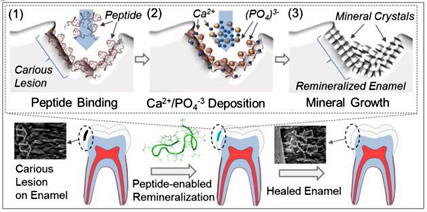
Taking inspiration from the body’s own natural tooth-forming proteins, the UW team has come up with a way to repair the tooth enamel. The researchers accomplished this by capturing the essence of amelogenin — a protein crucial to forming the hard crown enamel — to design amelogenin-derived peptides that biomineralize and are the key active ingredient in the new technology. The bioinspired repair process restores the mineral structure found in native tooth enamel.

Related: Heal Cavities, Gum Disease, Naturally with Organic Oral Care – Toothpaste recipes included

“These peptides are proven to bind onto tooth surfaces and recruit calcium and phosphate ions,” said Deniz Yucesoy, a co-author and a doctoral student at the UW.

The peptide-enabled technology allows the deposition of 10 to 50 micrometers of new enamel on the teeth after each use. Once fully developed, the technology can be used in both private and public health settings, in biomimetic toothpaste, gels, solutions and composites as a safe alternative to existing dental procedures and treatments. The technology enables people to rebuild and strengthen tooth enamel on a daily basis as part of a preventive dental care routine. It is expected to be safe for use by adults and children.

Co-authors are H. Fong, research scientist in the UW Department of Materials Science and Engineering, and Greg Huang, professor and chair of Orthodontics in the School of Dentistry.

Merger From Hell Approved By DOJ, Warnings Of Agrichemical Chokehold On Food System

(NaturalBlaze by Andrea Germanos) Watchdog groups sounded alarms on Monday after the Wall Street Journal reported that the proposed mega-merger of Bayer and Monsanto has cleared its final regulatory hurdle in the United States.

The reported approval from the Justice Department came “after the companies pledged to sell off additional assets,” the Journalreported, and despite concerns raised by hundreds of food and farm groups. It also comes weeks after the European Commission gave its thumbs up.

Related: Understanding and Detoxifying Genetically Modified Foods

“The approval of the third supersized seed merger, after ChemChina-Syngenta and Dow-DuPont,” said Wenonah Hauter, executive director of Food & Water Watch, “leaves farmers vulnerable to price gouging for seeds and other supplies and strengthens the hold a few dominant corporations have over the entire food system.”

“The Justice Department’s rubber stamping of these three seed mega-mergers transforms the already concentrated agrichemical and seed market, effectively reducing the number of competitors from six to three,” she added.

Because it will make it harder for farmers to acquire non-genetically modified seeds to plant, it “makes it harder for agriculture to get off the GMO-chemical treadmill that just keeps increasing in speed,” she said.

With its reported stamp of approval, the pending merger shows that “the federal government is not taking the impact of corporate control of our food supply seriously. It’s time for Congress to establish a moratorium on mega-mergers in the food system,” Hauter argued.

Related: Foods That Are GMO

Jason Davidson, food and technology campaign associate with Friends of the Earth, was equally critical in his reaction to the development.

“The Department of Justice has decided that corporate profits matter more than the interests consumers and farmers. This decision will massively increase the power of major agrichemical companies that already have a stranglehold on our food system,” he declared in a statement.

He went on to lament that “American farmers will see increased seed prices, fewer options, and decreased bargaining power.” Echoing Hauter’s warning, he argued. “This merger from hell will further entrench the failing model of toxic, chemical-intensive agriculture, which is poisoning people and the planet.”

Related: Doctors Against GMOs – Hear From Those Who Have Done the Research

A recent poll found that nearly 94 percent of farmers expressed concern that a Bayer-Monsanto merger would have a negative impact on independent farmers and their communities. It also found that 89 percent of farmers said they believe the merger would lead to increased pressure for chemically-dependent farming.

New Insight Into How “Gut Feelings” Affect Mental Health, Depression And Anxiety

(Natural Blaze by Alex Pietrowski) In recent years, the study of causes and treatments of depression has uncovered a link to the health of the microbiome within the body’s digestive system. The hypothesis is that the presence or absence of healthy digestive bacteria affects the way the brain functions, and new research by a Florida State University neuroscientist sheds more insight into this.

The findings by research and psychology professor Linda Rinaman point to a very important connection between the gut and the brain, identifying pathways that help to understand why so-called ‘gut feelings’ have a powerful influence on emotions, mood and decision-making.

Related: Sugar Leads to Depression – World’s First Trial Proves Gut and Brain are Linked (Protocol Included)

We expect these lines of research will help us better understand how gastrointestinal functions contribute to both normal and disordered mental function. ~Linda Rinaman

Her research looked at pathways between the gut and the brain in mammals, noting how feelings generated within the gut move into the brain, indicating that some ‘gut-feelings’ are a red flag and thereby may be a fair indicator of healthy mood and mental states.

In the human body, the vagus nerve acts as the pathway between the brain and gut. The nerve is the body’s largest and most extensive nerve, translating and carrying messages between the gastrointestinal tract and the brain. If the gut is operating optimally, the brain is cued to respond more positively. Food and proper supplementation are important factors.

Related: Candida, Gut Flora, Allergies, and Disease

Scientific and anecdotal evidence suggests a poor diet can cause those protective, cautionary signals to get out of whack, leading to altered mood and behavior. For example, Rinaman said, a high-fat diet can promote a low-grade inflammatory response in the GI tract, changing vagal signals and possibly exacerbating symptoms of anxiety, depression or other disturbed mental states.

Rinaman said the types of bacteria within your gut are shaped by your diet, and those bacteria can affect your emotional and cognitive state. [Source]

The emotional significance of the vagus nerve is discussed further:

Research indicates that a healthy vagus nerve is vital in experiencing empathy and fostering social bonding, and it is crucial to our ability to observe, perceive, and make complex decisions. Tests have revealed that people with impaired vagal activity have also been diagnosed with depression, panic disorders, Post Traumatic Stress Disorder (PTSD), irritable bowel syndrome, anxiety, panic disorders, violent mood swings, fibromyalgia, early Alzheimer’s and obesity. Given the state of society today and the vast array of dis-eases associated with unhealthy Vagus Nerves, it doesn’t take a medical doctor to conclude that by healing our collective Vagus Nerves, we can heal a lot of societies woes.

Scientists have discovered that artificial Vagus Nerve Stimulation (VNS), through electrical impulses via a surgically implanted pacemaker like device, shows promising results in reducing depression, anxieties and even conditions such as epilepsy and obesity. VNS has also shown positive effects in promoting weight-loss as the signals to the brain of ‘fullness’ are more easily transmitted. But what if there were a less intrusive and more natural way to stimulate and heal the Vagus Nerve? ~Frank Huguenard

Related: Gluten, Candida, Leaky Gut Syndrome, and Autoimmune Diseases

The important takeaway here is that supporting healthy gut function along with healthy function of the vagus nerve is being demonstrated to be a potentially very potent way of holistically approaching treatment of depression and anxiety.

Evidence shows that modifying the diet, perhaps by consuming probiotics, can impact your mood and behavioral state. That’s very clear in animal and human studies. ~Linda Rinaman

Keto Vs. Paleo – Here’s What Science Says About Which Low Carb Diet Is Best

(Natural Blaze by Anna Hunt) There will always be some type of low carb diet that gets the wellness community excited. Remember when Atkins and South Beach diets were the talk of the town? Pretty much most of these fad diets focus on decreasing intake sugar and carbohydrates. Today, two most popular low carb diets are the ketogenic diet and the paleo, or caveman, diet.

I’ve written quite a bit lately about the ketogenic diet because I’ve been inspired by this free keto diet cookbook. When I compared it to the paleo diet, I found that they are actually quite similar. So, does it matter which one you choose? Here are some comments from the scientific community that may help you decide which one (if either) is best for you.

Recommended: Detox Cheap and Easy Without Fasting – Recipes Included

Ketogenic Diet

A study published in Experimental & Clinical Cardiology examined the effects of a 24-week ketogenic diet. Researchers conducted the study on obese participants. The diet consisted of 30 g carbohydrate, 1 g/kg body weight protein, 20% saturated fat, and 80% polyunsaturated and monounsaturated fat. Here are the results:

The weight and body mass index of the patients decreased significantly (P<0.0001). The level of total cholesterol decreased from week 1 to week 24. HDL cholesterol levels significantly increased, whereas LDL cholesterol levels significantly decreased after treatment. The level of triglycerides decreased significantly following 24 weeks of treatment. The level of blood glucose significantly decreased.

Marcelo Campos, MD at Harvard Medical School, claims:

We have solid evidence showing that a ketogenic diet reduces seizures in children, sometimes as effectively as medication. Because of these neuroprotective effects, questions have been raised about the possible benefits for other brain disorders such as Parkinson’s, Alzheimer’s, multiple sclerosis, sleep disorders, autism, and even brain cancer.

He does add that the keto diet can be heavy on red meat and fatty, high-sodium, processed foods. Going keto doesn’t mean you can gorge on sausage and bacon! Be aware of where you’re getting your protein, and try to eat red meat in moderation. Also, get your healthy fats from live foods such as oils, nuts, seeds, fish, and avocados.

Recommended: Start Eating Like That and Start Eating Like This – Your Guide to Homeostasis Through Diet

Animal studies offer additional insights. One study evaluated the effects of a ketogenic diet on mice. The researchers published their finding in the journal Cell Metabolism. Here’s their conclusion:

A low-carbohydrate, ketogenic diet extends longevity in adult male mice.

Motor function, memory, and muscle mass are preserved in aged ketogenic mice.

Furthermore,  Scientific American reports:

Emerging evidence from animal models and clinical trials suggest keto may be therapeutically used in many other neurological disorders, including head ache, neurodegenerative diseases, sleep disorders, bipolar disorder, autism and brain cancer. With no apparent side effects.

Paleolithic Diet

A study in Nutrition Research examined if the paleo diet had a favorable effect on adults with high blood cholesterol levels. They compared it with the effects of the grain-based heart-healthy diet that the American Heart Association recommends.

Twenty volunteers who were not taking any cholesterol-lowering medications, participated. They adhered to a traditional heart-healthy diet for 4 months, followed by a Paleolithic diet for 4 months. The researchers concluded:

Paleolithic nutrition offers promising potential for nutritional management of hyperlipidemia in adults whose lipid profiles have not improved after following more traditional heart-healthy dietary recommendations.

Recommended: How to Make the Healthiest Smoothies – 4 Recipes

Another study took to understanding if the paleo diet has any effect on the risk of colon cancer. Researchers compared paleo to DASH (Mediterranean) diet, which many scientists believe can mitigate the risk of colon cancer. The researchers published their study in American Journal of Epidemiology. Here’s their conclusion:

These findings suggest that greater adherence to the Paleolithic diet pattern and greater adherence to the Mediterranean diet pattern may be similarly associated with lower risk of incident, sporadic colorectal adenomas.

Finally, the Journal of Diabetes Science and Technology published a review of several studies researching the effects of the paleo diet on Type 2 diabetes and cardiovascular disease. Here are some of the research findings:

The effect of a Paleolithic diet on a variety of metabolic risk factors for cardiovascular disease in an uncontrolled trial was reported in August 2009 in the European Journal of Clinical Nutrition. Compared with the usual diet, nine sedentary subjects receiving the intervention diet experienced (a) significant reductions in blood pressure, (b) improved arterial distensibility, (c) significant reduction in plasma insulin versus time in the area under the curve during oral glucose tolerance testing, and (d) significant reductions in total cholesterol, low-density lipoproteins, and triglycerides.

In terms of Type 2 diabetes, here is what one study revealed:

The Paleolithic diet compared to the diabetes diet resulted in a higher percentage of protein intake as a percentage of total daily calories. Therefore, the greater protein intake during a Paleolithic diet might confer an additional benefit (beyond weight reduction) in its favorable effects on risk reduction for metabolic disease.

Keto vs Paleo – What You Can & Can’t Eat

Below is a table that highlights the different foods you can and can’t eat when following the paleo and ketogenic dietary protocols.

Any Low Carb Diet Beats Typical Western Diet

I’ve been writing quite a bit lately about the ketogenic diet because I personally used it as a detox method for the new year. The goal is to help people realize that we do not need 50% to 80% of our diet to be made up of carbs.

Related: The Way We Used To Eat – The Real Paleo Diet

Many readers have taken offense to the idea that I would suggest people eat “so much meat.” Some have claimed that meat causes cancer. Then, there are the issues that factory farms are inhumane and a resource drain on the planet.

These are important issues. Yes, processed foods and overcooked red meat have been shown to be carcinogenic. I have written about this topic here.

The quality of the foods that you buy is very important. I would highly recommend growing as much as you can in your garden, including raising chickens. If you don’t have a back yard, then support local farms. Many of such farms raise their animals humanely and organically. If you are a vegan or vegetarian, these diets are clearly not for you.

In addition, people love to assert their beliefs that fats are only going to make you gain weight. Although there are now many studies showing the benefits of eating healthy fats, it’s a proven fact that people don’t easily let go of their old beliefs.

I know from personal experience that one can eat high-fat whole foods and still lose weight. This may not work for everyone, but it does work for some especially if you have an active lifestyle.

The real culprits in obesity are sugar and processed foods. With processed foods, people end up consuming many poor-quality fats. If you eat lots of greasy fries as part of your keto diet, then no, you probably won’t be any lighter or healthier.

If a person stopped eating high-fat processed foods, like cookies, chips and fried fast foods, the changes in their health and body would be quite noticeable. Eliminate sugary drinks and alcohol to boot, and you have yourself a very healthy diet. Even if you eat spaghetti once in a while.

What I’m getting at is that it doesn’t really matter what low carb diet, or no carb or some carb diet you choose. If you replace processed, fast and dead foods with nutrient-dense, live, real foods, your health will benefit.

Picking What Works for You

My goal here is not to talk you into going on any type of diet. Yet, many people find themselves unhealthy and overweight. Therefore, it is important to understand that there are many dietary options that have worked for others in terms of helping them improve their overall health and lose weight.

If you’re considering any dietary change, it is vital that you listen to your body. You are the primary person that will know if something is working or not. If you are taking medication or currently have an illness, you may want to discuss your dietary plan with your current medical provider.

Paleo, keto and even Whole 30 diets are a great way to reset the body. They all adhere to the idea that we need to stop eating so much sugar, processed foods, fried foods and grains (i.e. wheat products). Even if you eliminate these foods for a period of 4 to 8 weeks, your digestive system gets an opportunity to heal and reboot.

Finally, I want to congratulate anyone who has made the changes in their life and eats a keto or a paleo diet. It is a difficult process to let go of poor eating habits, and the Western culture does not make it easy. Please share with us your experiences, and any health benefits that you’ve observed.

Read more articles by Anna Hunt.

Anna Hunt is writer, yoga instructor, mother of three, and lover of healthy food. She’s the founder of Awareness Junkie, an online community paving the way for better health and personal transformation. She’s also the co-editor at Waking Times, where she writes about optimal health and wellness. Anna spent 6 years in Costa Rica as a teacher of Hatha and therapeutic yoga. She now teaches at Asheville Yoga Center and is pursuing her Yoga Therapy certification. During her free time, you’ll find her on the mat or in the kitchen, creating new kid-friendly superfood recipes.

This article (Keto vs Paleo – Here’s What Science Says About which Low Carb Diet is Best) was originally created and published by Waking Times and is published here under a Creative Commons license with attribution to Anna Hunt and WakingTimes.com. It may be re-posted freely with proper attribution, author bio, and this copyright statement.

Disclaimer: This article is not intended to provide medical advice, diagnosis or treatment. Views expressed here do not necessarily reflect those of Waking Times or its staff.