(Dr. Mercola) In November 2015, the U.S. Food and Drug Administration (FDA) approved AquaBounty salmon, a genetically engineered (GE) “frankenfish” that’s being touted as a way to solve overfishing and world hunger. The GE salmon are engineered to grow about twice as fast as typical farm-raised salmon, an eerie feat achieved by inserting the DNA from two other fish, a growth-promoting gene from a Chinook salmon and a “promoter” gene from the eel-like ocean pout.
This genetic tweaking results in fish with always-on growth hormone, and because they grow so much faster than other salmon, they also require less food. The fish are being grown on land and have several other supposed safeguards in place to prevent both escape and breeding with wild populations but, in nature, nothing is foolproof.
If you live in the U.S., the fish haven’t reached grocery store shelves — yet — but there’s a chance they could become the first GE animal food to be sold in the U.S. to date, with completely unknown consequences.
Recommended: Best Supplements To Kill Candida and Everything Else You Ever Wanted To Know About Fungal Infections
GE Salmon, Already Sold in Canada, May Soon Be in US Grocery Stores
While the FDA approved AquaBounty’s salmon over two years ago, a rider attached to an Alaskan budget bill imposed an import ban, effectively blocking the FDA from allowing GE salmon into the U.S. In Canada, however, the GE fish are already being sold and eaten, to the tune of 5 tons in 2017 (none of which were labeled as such).1 Meanwhile, AquaBounty has recently acquired a fish farm in Indiana, where they’re making plans to start raising GE salmon.
“That means the company’s salmon could be on sale in the U.S. by 2019, which would make it the first genetically modified animal food ever sold and eaten in this country,” wrote Richard Martin, senior editor for energy at S&P Global Market Intelligence, for BioGraphic. “Opposition, naturally, is fierce.”2
The creation of GE salmon is anything but natural. For the last 13 generations of AquaBounty salmon, dating back to a single GE fish from 1992, every fish carries a copy of the “mutant” gene set that leads to the supergrowth and is passed down to the next generation. As such, gene splicing doesn’t take place at every AquaBounty facility, although intense breeding of the GE fish does. Martin explained:3
“At spawning time, conventional females are milked of their eggs by hand, a method that requires two fish wranglers per female — one to handle the fish and another to hold the container that collects the eggs. The technicians use the same squeeze technique to extract semen, or ‘milt,’ from the males … When combined, the eggs and milt produce fertilized eggs.
The technicians place the developing embryos in a stainless-steel tube where they are subjected to high pressure. This renders all the embryos’ cells triploid, meaning they have three sets of chromosomes instead of two, which makes the fish incapable of reproducing …
After a period of incubation at the Bay Fortune hatchery [on Prince Edward Island, Canada], the sterile, all-female transgenic embryos are flown to a rearing facility in the highlands of Panama, where the resulting salmon are grown to maturity before being reimported into Canada …
Eventually, AquaBounty plans to produce market-ready fish at a new facility under construction at Rollo Bay, on Prince Edward Island, and at the Indiana facility — an existing fish production factory that belonged to a now-defunct aquaculture company.”
Recommended: How to Avoid GMOs in 2018 – And Everything Else You Should Know About Genetic Engineering
Most Americans Say They Would Not Eat GE Fish
In the U.S., negative public opinion has been instrumental in keeping GE fish off store shelves. In 2013, a New York Times poll revealed that 75 percent of respondents would not eat GE fish and 93 percent said such foods should be labeled as such.4 Yet, as in Canada, which does not require GE seafood to be labeled, the FDA concluded that AquaBounty salmon is “not materially different from other Atlantic salmon” and thus would not require any special labeling.5
If the frakenfish does end up in U.S. stores in the next year, then, you won’t be able to distinguish it from other salmon. Further, many experts are concerned that the release of GE salmon hasn’t been thought through and could pose a risk to wild salmon species.
Martin quoted Anne Kapuscinski, a professor of sustainability science at Dartmouth College, and George Leonard, chief scientist at the Ocean Conservancy, who stated, “The future of GE fish farming will surely involve larger fish farms, with less confinement, in many different environments.”6
As such, no one knows what future expansion could mean for the marine environment. A lawsuit led by the Center for Food Safety, and joined by U.S. tribes in the Pacific Northwest, including the Quinault Indian Nation, is challenging the FDA’s approval of AquaBounty’s salmon, alleging the agency “has not adequately assessed the full range of potentially significant environmental and ecological effects presented by the AquaBounty application.”7
Recommended: How Farmed Fish Degrades Our Health and the Environment – Better Options Included
The lawsuit is pending, but for now the FDA continues to maintain that AquaBounty’s salmon “is as safe to eat as any nongenetically engineered … Atlantic salmon, and also as nutritious.”8 They also state the approval “would not have a significant impact on the environment of the United States,” but the Center for Food Safety sees it differently, stating:9
“Salmon is a keystone species and unique runs have been treasured by residents for thousands of years. Diverse salmon runs today sustain thousands of American fishing families, and are highly valued in domestic markets as a healthy, domestic, ‘green’ food.
When GE salmon escape or are accidentally released into the environment, the new species could threaten wild populations by mating with endangered salmon species, outcompeting them for scarce resources and habitat, and/or introducing new diseases.
Studies have shown that there is a high risk for GE organisms to escape into the natural environment, and that GE salmon can crossbreed with native fish. Transgenic contamination has become common in the GE plant context, where contamination episodes have cost U.S. farmers billions of dollars over the past decade. In wild organisms like fish, it could be even more damaging.”
Aquaculture’s Farmed Salmon Are Environmentally Destructive
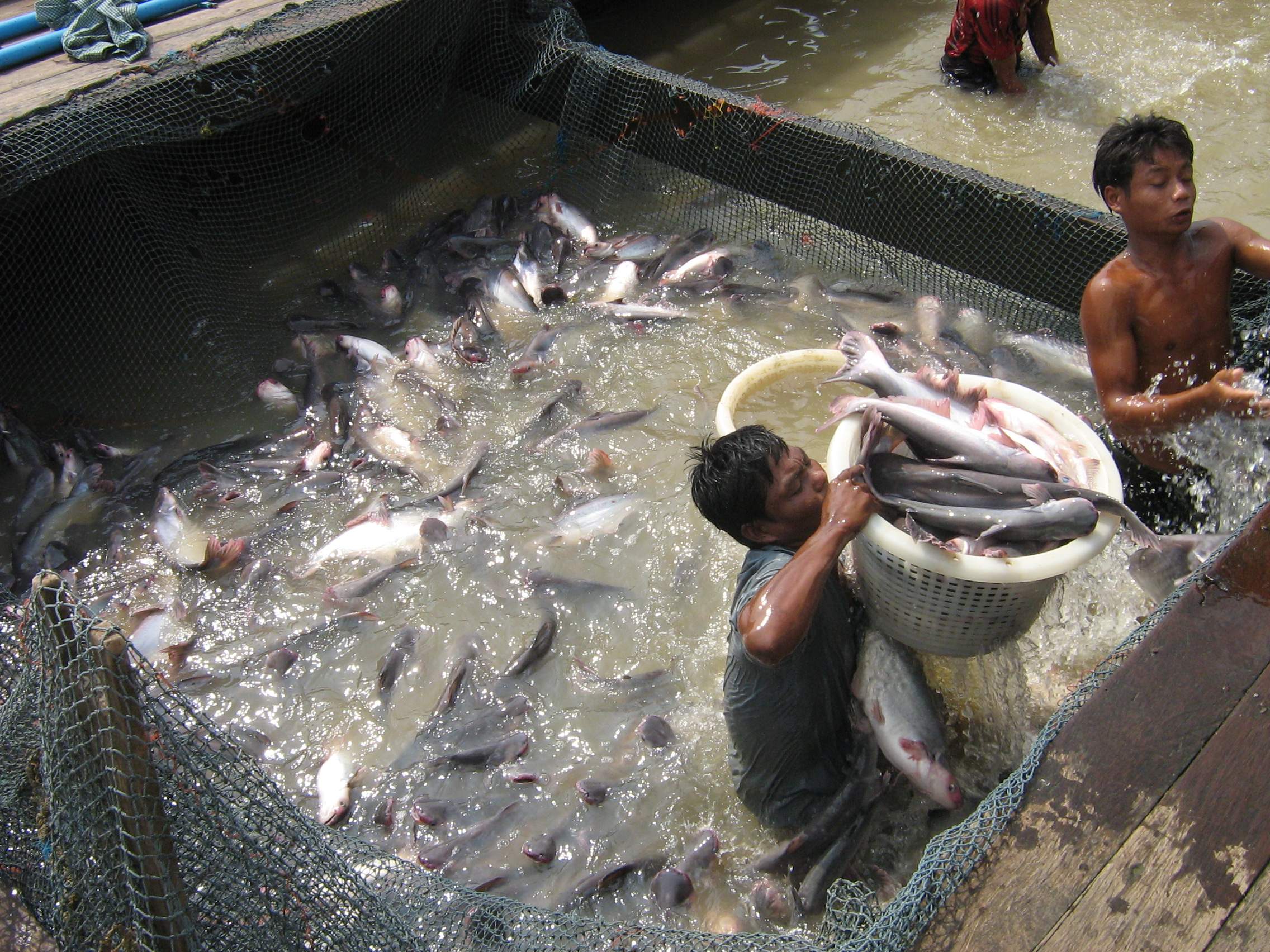
In the U.S., farmed salmon is one of the most popular seafood choices, with many being misled to believe it is a safe choice for dinner. In reality, while farmed salmon is not genetically engineered like AquaBounty’s frankenfish, it is still one of the worst seafood choices available in terms of pollutants and the environment. One of the major problems is that farmed salmon are typically raised in pens in the ocean, where their excrement and food residues are disrupting local marine life. The potential for escape is also high.
Even land-based salmon aquaculture is problematic, according to research published in Scientific Reports, which performed an analysis of four salmon aquacultures in Chile.10
The facilities, often described as CAFOs (concentrated animal feeding operations) of the sea, pump water from rivers into their hatcheries, then pump it back out to the river once it’s no longer clean. The researchers found the water is often contaminated with dissolved organic matter (DOM) — a mixture of liquid excrement, food residue and other salmon excretions, along with disinfectants and antibiotics.
The release of DOM into Chile’s rivers is causing significant ramifications for the entire ecosystem. Upstream of the fish farms, the researchers detected higher amounts of natural algae biofilms on rocks, which help to produce oxygen and provide food for organisms that fish later eat.
Downstream, however, biofilms had a greater abundance of bacteria, which use up oxygen and may lead to low-oxygen environments that could threaten many species. The researchers suggested that no additional fish farms should be installed on Chilean rivers, noting, “[R]ivers should not be misused as natural sewage treatment plants.”11
Viruses, Sea Lice From Farmed Salmon Threaten Wild Fish
Since farmed salmon pens are often placed along wild salmon runs, they pose a severe threat to wild salmon stocks that pass by, exposing wild fish to diseases that run rampant among the confined fish, such as sea lice, pancreas disease, infectious salmon anemia virus and piscine reovirus. Piscine reovirus is a highly contagious blood virus that causes heart disease in the affected fish.
The virus was first discovered in Norwegian salmon farms and has proven to be nearly impossible to eradicate. And, with the spread of this disease into wild populations, wild salmon may soon go extinct. Alexandra Morton, a Canadian marine biologist who has spent decades studying the impact of salmon farming on wild salmon, has also reported that sea lice from salmon farms are eating young wild salmon to death, while Canada’s Department of Fisheries and Oceans (DFO) has failed to take action.
In fact, an oceanic watchdog group recently reported a sea lice outbreak in Clayoquot Sound UNESCO Biosphere Reserve, located on the west coast of Vancouver Island in British Columbia, Canada.
Fish farms in the area had salmon lice up to 10 times higher than the rate that requires treatment, at numbers that could prove lethal to wild salmon. While DFO requires salmon farms to monitor and control sea lice via the use of chemicals in feed or hydrogen peroxide baths, the measures don’t appear to be working — and are toxic in and of themselves.
British Columbia has granted aquaculture company Cermaq Canada a permit to apply 2.3 million liters of Paramove 50, a pesticide, to 14 salmon farms in Clayoquot Sound in order to fight sea lice. Not only may the pesticide be toxic to other marine life such as Dungeness crab, prawns and herring, but it’s also known to suppress salmon immune systems, making them even more susceptible to viruses. In turn, wild salmon swimming by may be further exposed to deadly diseases.
“So just as the young salmon are passing by the farms, we could shock these farmed fish into getting PRV or that becoming HSMI (heart and skeletal muscle inflammation disease) which is deadly to wild salmon,” watchdog group Clayoquot Action Campaigns director Bonny Glambeck told The Narwhal.12 She continued in a news release:13
“This outbreak is an environmental disaster — we are seeing wild juvenile salmon carrying lethal loads of salmon lice … These fish have been given a death sentence … We don’t expect the new pesticides that they want to use will work. It’s not working in Norway right now. Studies show there is no way these fish will survive to spawn and reproduce … Basically the industry is unable to control sea lice. So that’s why we want to see these farms come out of the oceans.”
Tire Chemicals, PCBs Common in Farmed Salmon
Nutritionally speaking, farmed salmon are also a far inferior choice to the wild variety. For starters, their pens are often placed near shore, which means they’re close to land-based sources of pollutant runoff. In addition, they’re fed a diet of ground-up fishmeal, which may lead to concentrated levels of PCBs.
In a global assessment of farmed salmon published in the journal Science, PCB concentrations in farmed salmon were found to be eight times higher than in wild salmon.14 Similarly, when the Environmental Working Group (EWG) tested farmed salmon from U.S. grocery stores, they found farmed salmon had, on average:15
- 16 times more PCBs than wild salmon
- 4 times more PCBs than beef
- 3.4 times more PCBs than other seafood
Further, ethoxyquin, developed by Monsanto in the 1950s, is a rubber stabilizer (used in the production of tires), pesticide, preservative and antioxidant all in one that’s often added to farmed salmon feed. While it doesn’t have the health benefits normally associated with dietary antioxidants, it does prevent oxidation of fats, which is why it’s used in different types of animal feed, including fish feed and pet food.16
But studies have also shown ethoxyquin adversely affects cell metabolism, especially the metabolic pathways of renal and hepatic cells in rats, and the mitochondria in bovine hearts and kidneys. Due to its potential toxicity, the EU has strict limits for ethoxyquin levels in fruits, nuts, vegetables and meat. However, since it was never intended for use in fish, and fish feed manufacturers never informed health authorities that they were using it, there are no limits on how much of the chemical is allowed in seafood.
On top of more toxins, farmed salmon lack the correct ratio of healthy fats that many people are seeking when eating a “healthy” fish meal. Half a fillet of wild Atlantic salmon contains about 3,996 milligrams (mg) of omega-3 and 341 mg of omega-6.17 Half a fillet of farmed salmon from the Atlantic contains just a bit more omega-3 — 4,961 mg — but an astounding 1,944 mg of omega-6;18 more than 5.5 times more than wild salmon.
While you need both omega-3 and omega-6 fats, the ratio between the two is important and should ideally be about 1-to-1. The standard American diet is already heavily skewed toward omega-6, thanks to the prevalence of processed foods, and with farmed salmon, that unhealthy imbalance is further magnified rather than corrected.
Choose Wild Salmon for Your Health — and the Environment
If you’re wondering how can you tell whether salmon is wild or farm-raised, the flesh of wild sockeye salmon is bright red, courtesy of its natural astaxanthin content. It’s also very lean, so the fat marks, those white stripes you see in the meat, are very thin. If the fish is pale pink with wide fat marks, the salmon is farmed. Avoid Atlantic salmon, as typically salmon labeled “Atlantic Salmon” currently comes from fish farms.
The two designations you want to look for are “Alaskan salmon” and “sockeye salmon,” as Alaskan sockeye is not allowed to be farmed. So canned salmon labeled “Alaskan Salmon” is a good bet, and if you find sockeye salmon, it’s bound to be wild. As for GE salmon, if it comes to your grocery store it’s not currently slated to be labeled as such, but it’s another variety of Atlantic salmon, so steering clear of Atlantic salmon in favor of wild varieties will help you steer clear of adding this frankenfish to your dinner plate.