Most University Medical Research Brought To You By Big Pharma

(Natural Blaze by Brandon Turbeville) Partly a result in the decrease in government funding in innovation, health, science, and general development and partly a result of the close connection between major corporations, government, and academia, there has been a major increase in the “financial partnerships” between universities and Big Pharma over the past several years. Once a relatively rare occurrence, Big Pharma/Big Ed partnerships have become a common sight, with many corporations maintaining massive “integrated programs” and “science hubs” in university institutions. The focus of these programs are not necessarily public health but the development of drugs for Big Pharma profits.

GlaxoSmithKline at Harvard, AstraZeneca at the University of Washington, and Pfizer at the University of California are some of the most glaring examples, but they are by no means even the tip of the iceberg in Big Pharma/Big Ed partnerships. As SOTT.net writes in its article “Big Pharma Pays Universities For Most Medical Research In the United States,

In fact, with the increasing financial ties between academia and the pharmaceutical industry, many drug companies have formed specialized divisions that are solely responsible for seeking research and development relationships with academic institutions.”

Related: Doctors Against Vaccines – Hear From Those Who Have Done the Research

One such reason for a greater reliance on Big Pharma for research money is the decline in interest of the U.S. government to fund projects that would theoretically benefit human health and increase living standards through progress and development. For instance, a report in the British Medical Journal stated that “An estimated 60% of biomedical research and development in the United States is now privately funded, and two thirds of academic institutions have equity ties with outside sponsors.” In other words, over half of the medical research conducted at universities is conducted with funding from Big Pharma itself.

A review published in the Mens Sana Monograph suggests that,

This need for large funds is, moreover, coupled with the desire to acquire it without making a dent in one’s own pockets. The easiest way that can happen is getting an interested party to fund it, which has a big stake in the success of the entire venture. Hence, the pharmaceutical industry becomes a willing partner in the whole enterprise.

Related: The MMR Vaccine – A Comprehensive Overview of the Potential Dangers and Effectiveness

The Washington Post, surprisingly, explains one reason such heavy corporate funding is a bad idea. It states,

The billions that the drug companies invest in such experiments help fund the world’s quest for cures. But their aim is not just public health. That money is also part of a high-risk quest for profits, and over the past decade corporate interference has repeatedly muddled the nation’s drug science, sometimes with potentially lethal consequences

Ever since the 1980s, more money for medical research has come from Big Pharma than from grants awarded by the NIH. In 2011, Big Pharma spent $39 billion while the NIH only spent $31 billion. This is in part a testament to the fact that, while the U.S. can waste billions on foreign wars and foreign aid, it is pinching pennies with research that could benefit its own people back home. But it’s also a revelation of just how close corporate interests and the University Industrial Complex actually are. Thus, it’s very concerning when one of the greatest forces for cultural “revolution” and Big Pharma are teaming up to such an openly high level.

Editor’s Note: “Industry-sponsored clinical trials are four times more likely to report positive results than non-industry sponsored clinical trials.”

In addition, SOTT writes of how this growing partnership raises some serious conflict of interest questions. The website writes,

It is no secret that relationship between doctors and pharmaceutical companies has involved significant financial entanglement, consequently opening a debate on conflict of interest issues.4 Financial incentives provided by drug companies have influenced doctors to engage in inappropriate prescribing habits to promote the purchase and use of the sponsoring company’s drug, thus questioning the credibility of both parties involved.4

This same type of cozy relationship is now becoming prominent between academics and pharmaceutical companies. While financial relationships between doctors and drug companies has come under significant scrutiny, less attention is being paid to financial relationships between academics and the drug industry.4

There is enough evidence to document conflict of interest issues between academics in leadership positions and the drug industry. A study published in the Journal of the American Medical Association reveals:

Almost every major U.S.- based pharmaceutical company in 2012-and nearly 40 percent worldwide-had at least one board member in a leadership position from a U.S. academic medical center, raising potentially problematic conflict-of-interest questions. The board members were compensated an average of $312,564 by the pharmaceutical companies, while concurrently holding clinical or administrative leadership positions at academic medical centers.6

The study’s senior author, Welld Gallad, MD, MPH points out:

[P]harmaceutical industry board membership by academic medical center leaders could lead to a different kind of potential conflict of interest, since academic leaders wield considerably more influence over research, clinical and educational missions than ordinary physicians or staff who may be targeted for gifts by pharmaceutical representatives.6

Scientifically Proven Method to Reverse Diabetes (Ad)

Dr. Gallad adds:

The public will have to decide whether these non-profit, and in many cases publicly funded, academic institutions can manage these potential conflicts with internal policies, or whether additional regulation is needed.6

. . . . .

A significant amount of vaccine related research is now being conducted at American academic institutions. Many universities now have their own vaccine research centers, with pharmaceutical companies funding many of the studies. Professors and other academic scientists who conduct these studies often also have personal financial relationships with vaccine manufacturers. This conflict of interest may or may not be revealed in the study’s original publication, depending upon the medical journal in which the study is published.

Concerns have been voiced about the pharmaceutical industry’s lack of transparency with regard to the development and side effects of FDA licensed drugs and vaccines and financial relationships with the medical profession, which promotes the use of those drugs and vaccines. It is logical to ask whether the public can trust the conclusions of vaccine research conducted by academic institutions heavily funded by vaccine manufacturers, which may incentivize researchers to steer research toward conclusions that suit the financial interests of those companies.

One does not need to look too far in order to see that the University research/Big Pharma partnership is creating a dangerous culture. Many academics survive on grants either by government or by corporations and a researcher might be ending his own career if he bucks the institution which is paying for the gravy train. This is one reason university scientists, researchers, and academics are some of the most vociferous guard dogs and defenders of corporations. With Big Pharma paying the bills of most medical research conducted in the United States, there is no wonder why Big Ed is simply becoming the validator of industry science in the sickest nation on the planet. Come to think of it, there is no wonder why the United States is the sickest nation on the planet.

Hat tip to SOTT “Big Pharma Pays Universities For Most Medical Research In The United States

Organic Agriculture Is Going Mainstream, But Not The Way You Think It Is

(The Conversation) One of the biggest knocks against the organics movement is that it has begun to ape conventional agriculture, adopting the latter’s monocultures, reliance on purchased inputs and industrial processes.

“Big Organics” is often derided by advocates of sustainable agriculture. The American food authors Michael Pollan and Julie Guthman, for example, argue that as organic agriculture has scaled up and gone mainstream it has lost its commitment to building an alternative system for providing food, instead “replicating what it set out to oppose.”

New research, however, suggests that the relationship between organic and conventional farming is more complex. The flow of influence is starting to reverse course.

Practitioners of conventional agriculture are now borrowing “organic” techniques to reduce the use of pesticides, artificial fertilizers and excessive tillage, and to increase on-farm biodiversity, beneficial insects and soil conservation.

All of a sudden, many conventional vegetable farms are starting to look organic.

Organic goes mainstream

Next to nothing has been written on this subject. A rare exception is a 2016 article in the New York Times that profiled conventional farmers in Indiana who had started to use “cover crops.”

These non-commercial crops build organic matter into the soil, fix atmospheric nitrogen and add biodiversity to an agroecosystem, while allowing farmers to reduce artificial fertilizer inputs.

As organic agriculture has scaled up, it has gained credibility in the marketplace as well as on the farm. Organic farming has roots in market gardens and smaller farms, but there is nothing that prohibits organic production at larger scales.

That often means bigger farms, hundreds — or thousands — of acres in size.

This move toward the mainstream has caught the eye of many conventional farmers, who have either transitioned to certified organic production or begun to integrate organic practices on conventional plots.

Market share not the whole story

Even with the upscaling, the market position of organic agriculture remains limited.

In Canada, organic sales grow by nearly 10 per cent per year, and the total value of the organic market is around $5.4 billion. Yet the reality is that the industry is still dwarfed by conventional agriculture.

There are more than 4,000 certified organic farms in Canada, totalling 2.43 million acres. But this accounts for only 1.5 per cent of the country’s total agricultural land.

Also, aside from the two organic heavyweights — coffee (imported) and mixed greens (mostly imported) — the market share of organic groceries is pretty small, at around three per cent.

Yet the influence of organics is felt well beyond its own limited market.

Testing the market

Many growers divide their farms into separate conventional and certified organic zones. This “split production” is a way to learn organic growing, test the market and hedge one’s bets against yield issues.

In 2017, as part of a research project on organic transition funded by the Canadian Organic Growers (COG), I travelled across the country and conducted in-depth interviews at farms that had recently transitioned from conventional to organic farming.

Half of the 12 farms I visited practised split production. What’s significant (and totally unanticipated) is that all of the farms in split production had also introduced organic techniques to the conventional portions of the operation.

With familiarity came trust.

Adopting organic techniques

These are not mom-and-pop operations. The list includes Canada’s biggest organic vegetable operation — Kroeker Farms/PoplarGrove in Winkler, Manitoba — and many other large vegetable farms across the country.

They used compost, manure and/or cover crops, had cut back on toxic and persistent pesticides, reduced tillage and embraced longer and more biodiverse crop rotations. In the process, they had also protected and promoted pollinators and beneficial insect predators.

Kroeker Farms, a megafarm that has 4,800 acres under organic production and another 20,000 or so in conventional production, is leading the trend toward a more organic-like conventional system.

“We try really, really hard to use organic-type pesticides or biological [control agents] in our conventional because once you spray with a more lethal spray that’s a broad spectrum [pesticide], the pests flare up after that,” the CEO of the company, Wayne Rempel, told me.

Trending nationally

Similar trends are found across the country.

In Prince Edward Island, Red Soil Organics has begun to plant fall rye — a classic organic cover crop — as part of the rotation on its conventional side, a bit like those farmers in Indiana.

Another PEI farm, Square One Organics, uses cover crops, manure and tine weeding (a common, low-impact, mechanical weeding technique used on organic farms) on their conventional plots.

The cover crops and manure have allowed the farm to reduce its use of nitrogen fertilizer by about 10 per cent. This reduces nitrogen runoff into waterways, which can cause algae blooms and kill aquatic species.

The combination of tine weeding and perennial cover crops has also allowed the farm to reduce or eliminate herbicide use on the conventional side of the farm. “We’re managing our soil organic matter in totally different ways,” says owner Matt Ramsay.

It’s impossible to know the cumulative ecological benefits of this growing trend. Organic techniques, such as composting and the use of cover crops, are not tracked closely by Statistics Canada. With more research, we might have a better sense of the benefits.

Grounds for action

The motivations are easier to define. Farmers have made it clear that organic techniques work well, organic inputs are generally cheaper than conventional ones, and organic practices have a beneficial impact on the agroecosystem.

Yet until a conventional farmer begins the transition to certified organic growing, he or she often knows or cares little about organic practices. Right now, the best way for a farmer to learn about organic growing is by reading handbooks, attending conferences and taking courses.

The ConversationIt might be the case that Big Organics has begun to look like conventional farming. But it appears to be the case that, at least on some Canadian farms, Big Conventional is starting to look like organic.


Jeremy Lawrence Caradonna, Adjunct Professor of Environmental Studies, University of Victoria

‘Astronomical’ Cost of War: Average US Taxpayer Sent $3,456 to Pentagon Last Year and Just $39 to the EPA

(Common Dreams by ) “Congress appropriates more for U.S. military spending than the next eight countries combined, but year after year refuses to adequately invest in access to quality education and healthcare for millions of Americans.”

Image Credit: National Vanguard

As Americans rushed to pay their taxes on Tuesday before the official deadline, peace groups reminded the public of the uncomfortable fact that an “astronomical amount” of the money sent to the IRS each year goes not to funding education or a single-payer healthcare system the U.S. supposedly can’t afford, but straight into the bloated coffers of the Pentagon.

Arms industry executives make out like bandits while programs that provide essential services for most Americans remain drastically underfunded.” – Paul Kawika Martin, Peace Action

“Congress appropriates more for U.S. military spending than the next eight countries combined, but year after year refuses to adequately invest in access to quality education and healthcare for millions of Americans, infrastructure spending, and alternative energy,”  Paul Kawika Martin, senior director for policy and political affairs at Peace Action, said in a statement late Monday.

“As a result, arms industry executives make out like bandits while programs that provide essential services for most Americans remain drastically underfunded, as do development and diplomacy programs that help end wars and prevent them in the first place,” Martin added.

Highlighting America’s uniquely exorbitant military spending in a blog post on Tuesday, Lindsay Koshgarian of National Priorities noted that it is particularly important to keep in mind who funds U.S.-led endless wars overseas following President Donald Trump’s illegal attack on Syria—an attack that “added nearly $5 billion to missile-makers’ stock value.”

“It’s devastating to know who paid for it: we did,” Koshgarian observed.

“The average taxpayer contributed $3,456 to the military in 2017,” she noted, compared to $80 that went to welfare programs and “just $39 to the Environmental Protection Agency.”

In an analysis published last month, National Priorities estimated that 23.8 cents of every dollar in taxes paid in 2017 went to Pentagon and military spending.

“Meanwhile, 11 cents goes to military contractors, including 1.7 cents for the Pentagon’s biggest contractor and maker of the F-35 jet fighter, Lockheed Martin,” the group found.

A 10 percent cut in spending on military contractors would provide enough money to hire 395,000 elementary school teachers or provide health insurance for 13 million children.” – Lindsay Koshgarian, National Priorities Project

Writing for Truthout on Tuesday, Koshgarian pointed out that the political choice to devote such massive sums of taxpayer money to the Pentagon and corporate war profiteers has very “real consequences.”

“A 10 percent cut in spending on military contractors would provide enough money to hire 395,000 elementary school teachers or provide health insurance for 13 million children,” Koshgarian observed.

If Trump and Republican lawmakers have their way, Americans could soon be dumping even more tax money into the American war machine while healthcare, food stamps, education, and other public programs are slashed.

As Common Dreams reported last month, Trump signed an omnibus spending bill that contained $700 billion in Pentagon funding, and he has asked for an even bigger military budget for next year.

Massachusetts Peace Action highlighted a breakdown of the president’s proposed budget for fiscal year 2019:

Taking Aim at Corporate Impunity, Sanders’ Bill Would Send Big Pharma Execs Behind Opioid Crisis to Jail

(Common Dreams by Julia Conley) “We know that pharmaceutical companies lied about the addictive impacts of opioids they manufactured…Not one of them has been held fully accountable for its role in an epidemic that is killing tens of thousands of Americans every year.”

While President Donald Trump attempts to place blame for the enduring opioid addiction crisis on immigrants, Sen. Bernie Sanders (I-Vt.) announced Tuesday that he would introduce legislation to take aim at those who drug policy experts agree are truly behind the epidemic that kills tens of thousands of Americans per year—pharmaceutical companies and executives.

“At a time when local, state and federal governments are spending many billions of dollars a year dealing with the impact of the opioid epidemic, we must hold the pharmaceutical companies and executives that created the crisis accountable,” said Sanders in a statement.

Recommended: Opioids No Better than NSAIDs for Chronic Back or Arthritis Pain

The bill (pdf) would threaten Big Pharma executives with at least 10 years in prison should their companies be found guilty of contributing to the opioid crisis through manipulative marketing practices. Executives would also face fines equal to their total compensation packages, while companies would be fined $7.8 billion—one-tenth of the annual cost of the public health epidemic, according to government estimates.

Under the legislation, companies would be required to clearly state that opioids are addictive in any marketing materials for the drugs, which include popular brands including OxyContin, Vicodin, and Percocet.

The roots of the opioid crisis are traced back to the 1990s, when Purdue Pharma, the maker of OxyContin, began marketing the drug as safe for long-term use for chronic pain, denying that prescription opioids—which are chemically similar to heroin—had highly addictive properties.

Recommended: Drug Firms Profiting From Addiction – Shipping Massive Quantities of Opioids To West Virginia

After opioid painkiller prescriptions skyrocketed as a result, the rate of overdose began to rise as well, with opioid overdoses killing at least 63,000 Americans in 2016.

In Ohio next year, Purdue is one of several drug companies that will face a jury trial over a lawsuit accusing them of “deceptively marketing opioids” and alleging distributors “ignored red flags indicating the painkillers were being diverted for improper uses.”

But Sanders noted that no company has truly been held liable for the epidemic, which Purdue alone has make tens of billions of dollars off of in recent years:

In 2007, Purdue Pharma…pled guilty and agreed to pay more than $600 million in fines for misleading the public about the risks of the drug. But the company still made $22 billion off of the drug in the past decade.

Recommended: U.S. Life Expectancy To Decline, CDC Blames Pharmaceutical Companies

“We know that pharmaceutical companies lied about the addictive impacts of opioids they manufactured,” said Sanders. “They knew how dangerous these products were but refused to tell doctors and patients. Yet, while some of these companies have made billions each year in profits, not one of them has been held fully accountable for its role in an epidemic that is killing tens of thousands of Americans every year.”

Future Dental Product May Cure Cavities

(Natural Blaze) Researchers at the University of Washington have designed a convenient and natural product that uses proteins to rebuild tooth enamel and treat dental cavities.

The “modern” theory of dental disease suggests that we have an almost total lack of power and responsibility concerning this condition. Children’s cavities are on the rise, and children today who have cavities are requiring more expensive and extensive dental surgery to hide the problems of dental decay.

Related: Three Homemade Toothpaste Recipes – Better Oral Health for Less Cost

The research finding was first published in ACS Biomaterials Science and Engineering.

“Remineralization guided by peptides is a healthy alternative to current dental health care,” said lead author Mehmet Sarikaya, professor of materials science and engineering and adjunct professor in the Department of Chemical Engineering and Department of Oral Health Sciences.

The new biogenic dental products can — in theory — rebuild teeth and cure cavities without today’s costly and uncomfortable treatments.

“Peptide-enabled formulations will be simple and would be implemented in over-the-counter or clinical products,” Sarikaya said.

Cavities are more than just a nuisance. According to the World Health Organization, dental cavities affect nearly every age group and they are accompanied by serious health concerns. Additionally, direct and indirect costs of treating dental cavities and related diseases have been a huge economic burden for individuals and health care systems.

Related: Periodontal Disease, Gum Disease – What you need to know (with recipes)

“Bacteria metabolize sugar and other fermentable carbohydrates in oral environments and acid, as a by-product, will demineralize the dental enamel,” said co-author Sami Dogan, associate professor in the Department of Restorative Dentistry at the UW School of Dentistry.

Although tooth decay is relatively harmless in its earliest stages, once the cavity progresses through the tooth’s enamel, serious health concerns arise. If left untreated, tooth decay can lead to tooth loss. This can present adverse consequences on the remaining teeth and supporting tissues and on the patient’s general health, including life-threatening conditions.

Good oral hygiene is the best prevention, and over the past half-century, brushing and flossing have reduced significantly the impact of cavities for many Americans. Still, some socio-economic groups suffer disproportionately from this disease, the researchers said. And, according to recent reports from the Centers for Disease Control and Prevention, the prevalence of dental cavities in Americans is again on the rise, suggesting a regression in the progress of combating this disease.

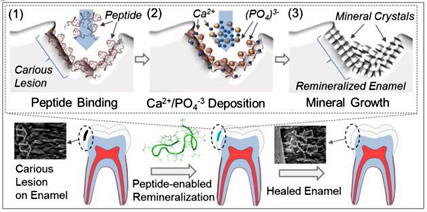
Taking inspiration from the body’s own natural tooth-forming proteins, the UW team has come up with a way to repair the tooth enamel. The researchers accomplished this by capturing the essence of amelogenin — a protein crucial to forming the hard crown enamel — to design amelogenin-derived peptides that biomineralize and are the key active ingredient in the new technology. The bioinspired repair process restores the mineral structure found in native tooth enamel.

Related: Heal Cavities, Gum Disease, Naturally with Organic Oral Care – Toothpaste recipes included

“These peptides are proven to bind onto tooth surfaces and recruit calcium and phosphate ions,” said Deniz Yucesoy, a co-author and a doctoral student at the UW.

The peptide-enabled technology allows the deposition of 10 to 50 micrometers of new enamel on the teeth after each use. Once fully developed, the technology can be used in both private and public health settings, in biomimetic toothpaste, gels, solutions and composites as a safe alternative to existing dental procedures and treatments. The technology enables people to rebuild and strengthen tooth enamel on a daily basis as part of a preventive dental care routine. It is expected to be safe for use by adults and children.

Co-authors are H. Fong, research scientist in the UW Department of Materials Science and Engineering, and Greg Huang, professor and chair of Orthodontics in the School of Dentistry.