Study: How Coca-Cola Declared War on the “Public Health Community”

The Coca-Cola Company proposed and financed the now-defunct group Global Energy Balance Network as a “weapon” in the “growing war between the public health community and private industry” over obesity and the obesity epidemic, according to a new study published today in the Journal of Epidemiology and Community Health.

The study is based on documents obtained via state Freedom of Information request by U.S. Right to Know, a consumer and public health group.

The study states that “The documents reveal that Coca-Cola funded and supported the GEBN because it would serve as a ‘weapon’ to ’change the conversation’ about obesity amidst a ’growing war between the public health community and private industry’.”

“This study reveals The Coca-Cola Company’s true intentions to go to war with the public health community over obesity and who is responsible for it,” said Gary Ruskin, co-director of US Right to Know, a co-author of the study.

Other co-authors of the study are: Pepita Barlow, University of Oxford; Paulo Serôdio, University of Oxford; Professor Martin McKee, London School of Hygiene and Tropical Medicine; and Professor David Stuckler, Bocconi University.

The title of the article in the Journal of Epidemiology and Community Health is: “Science organisations and Coca-Cola’s ‘war’ with the public health community: insights from an internal industry document”.

U.S. Right to Know is a nonprofit consumer and public health organization that investigates the risks associated with the corporate food system, and the food industry’s practices and influence on public policy.  For more information, see usrtk.org.

Related:

World Famous Psychiatrist Says: More Psychiatric Drug Treatment Means More Shootings Will Happen

(Natural Blaze by Jon Rappoport) Listen to this man. You’d better listen.

His name is Peter Breggin. He is a world famous psychiatrist. He has been called the conscience of his profession.

Here is an excerpt from his bio:

“Peter R. Breggin MD is a Harvard-trained psychiatrist and former Consultant at NIMH [National Institute of Mental Health] who has been called ‘The Conscience of Psychiatry’ for his many decades of successful efforts to reform the mental health field. His work provides the foundation for modern criticism of psychiatric diagnoses and drugs, and leads the way in promoting more caring and effective therapies. His research and educational projects have brought about major changes in the FDA-approved Full Prescribing Information or labels for dozens of antipsychotic and antidepressant drugs. He continues to education the public and professions about the tragic psychiatric drugging of America’s children.”

Recommended: Holistic Guide to Healing the Endocrine System and Balancing Our Hormones

“Dr. Breggin has authored dozens of scientific articles and more than twenty books, including medical books and the bestsellers Toxic Psychiatry and Talking Back to Prozac. Two more recent books are Medication Madness: The Role of Psychiatric Drugs in Cases of Violence, Suicide and Crime and Psychiatric Drug Withdrawal: A Guide for Prescribers, Therapists, Patients and their Families.”

“Dr. Breggin has unprecedented and unique knowledge about how the pharmaceutical industry too often commits fraud in researching and marketing psychiatric drugs. He has testified many times in malpractice, product liability and criminal cases, often in relation to adverse drug effects…”

Here is an explosive excerpt from Dr. Breggin’s recent column at Mad In America: “Psychiatrist Says: More Psychiatry Means More Shootings”:

“In the early 1990s, a federal court-appointed me to be the scientific expert for all of the combined product liability cases that were brought against Eli Lilly throughout the country concerning Prozac-induced violence, suicide and crime. Since then I have been involved in many cases in which judges and juries, and even prosecuting attorneys, have determined that psychiatric drugs have caused or substantially contributed to violence. For a lengthy list, see the Legal Section on my website [www.breggin.com].”

“In 2003/2004, I wrote a scientific review article about antidepressant-induced suicide, violence and mania which the FDA distributed to all its advisory committee members. This took place as the FDA Advisory Committee members prepared to review new warnings to be put in the Full Prescribing Information for all antidepressants.”

Recommended: Sugar Leads to Depression – World’s First Trial Proves Gut and Brain are Linked (Protocol Included)

“In my peer-reviewed paper [about the effects of antidepressants], I wrote: ‘Mania with psychosis is the extreme end of a stimulant continuum that often begins with lesser degrees of insomnia, nervousness, anxiety, hyperactivity and irritability and then progresses toward more severe agitation, aggression, and varying degrees of mania.”

“In words very close to and sometimes identical to mine, the FDA one year later required the manufacturers of every antidepressant to put the following observations in the Warnings section of the Full Prescribing Information:”

“’All patients being treated with antidepressants for any indication should be monitored appropriately and observed closely for clinical worsening, suicidality, and unusual changes in behavior, especially during the initial few months of a course of drug therapy, or at times of dose changes, either increases or decreases. The following symptoms, anxiety, agitation, panic attacks, insomnia, irritability, hostility, aggressiveness, impulsivity, akathisia (psychomotor restlessness), hypomania, and mania, have been reported in adult and pediatric patients being treated with antidepressants for major depressive disorder as well as for other indications, both psychiatric and nonpsychiatric’.”

“These adverse drug effects—including agitation, irritability, hostility, aggressiveness, akathisia, and impulsivity—are an obvious prescription for violence. Akathisia, which I also described in my article, is a psychomotor agitation that is strongly associated with violence.”

“The FDA Medication Guide for antidepressants warns clinicians, patients and families to be on the alert for the following:

  • acting on dangerous impulses
  • acting aggressive or violent
  • feeling agitated, restless, angry or irritable
  • other unusual changes in behavior or mood”

“This list (above) of antidepressant adverse effects from the Medication Guide should make clear that antidepressants can cause violence.”

“The FDA also acknowledges the risk of both psychosis and aggression from the stimulant drugs used to treat ADHD…”

“In the study of violence reports to the FDA, any predisposition toward violence in the patients themselves was largely ruled out because some of the most violence-inducing drugs were not psychiatric drugs, and were being given to a more general population. Some of the violence-inducing drugs were antibiotics, including Lariam (Mefloquine), which Sgt. Robert Bales was taking when he slaughtered 16 helpless, innocent villagers in Afghanistan.”

“[The authorities] do not foresee that the psychiatric strategy for treatment will sometimes lead to tragic outcomes like the school shootings. Nor do they realize that the overall evidence of harm from psychiatric drugs is infinitely greater than the evidence for good effects, as scientist Peter Gøtzsche has confirmed in Deadly Psychiatry and Organized Denial.”

“Calling for more spending on mental health and on psychiatry will make matters worse, probably causing many more shootings than it prevents.”

Recommended: Gluten, Candida, Leaky Gut Syndrome, and Autoimmune Diseases

“Not only do psychiatric drugs add to the risk of violence, but psychiatric treatment lulls the various authorities and the family into believing that the patient is now ‘under control’ and ‘less of a risk.’ Even the patient may think the drugs are helping, and continue to take them right up to the moment of violence.”

“Even when some of their patients signal with all their might that they are dangerous and need to be stopped, mental health providers are likely to give drugs, adding fuel to the heat of violent impulses, while assuming that their violence-inducing drugs will reduce the risk of serious aggression.”

NOTE: DR. BREGGIN ISSUES THIS WARNING: “Most psychiatric drugs can cause withdrawal reactions, including life-threatening emotional and physical reactions. So it is not only dangerous to start psychiatric drugs, it can also be dangerous to stop them. Withdrawal from psychiatric drugs should be done carefully under experienced clinical supervision. Methods for safely withdrawing from psychiatric drugs are discussed in Dr. Breggin’s book: Psychiatric Drug Withdrawal: A Guide for Prescribers, Therapists, Patients and Their Families.”

My comments: The tragedy of many mass shootings—many more than are highlighted by the press—is mirrored by the tragedy of psychiatric drug treatment.

Overwhelmingly, psychiatrists bury their heads in the sand, as they continue to dose patients with compounds that cause horrendous effects, including violence.

The psychiatric solution to mass shootings—more diagnosis and more drugs—becomes the cause for increased shootings.

Many mainstream reporters are aware of this, but they are constrained from telling the whole truth. Their media outlets are relying on pharmaceutical advertising for their very existence.

Legal authorities make it very difficult, if not impossible, to obtain information about which psychiatric drugs shooters were taking before they went on their rampages. Case in point, Sandy Hook, 2012—the (purported) killer, Adam Lanza, had been under psychiatric treatment. But an assistant attorney general for the state of Connecticut stated that the list of Lanza’s meds would not be disclosed, because that “can cause a lot of people to stop taking their medications.” Better for patients to keep taking those drugs—and then some of them will violently go off on innocent persons.

Recommended: Hypothyroidism – Natural Remedies, Causes, and How To Heal the Thyroid

In conversations with attorneys over the years, I’ve been told that judges, police officers, and prosecutors avoid the “psychiatric drug issue.” They don’t want to touch it. After all, friendly psychiatrists are part of the legal system. They often testify at trials. Further, “medical experts” will lash out and go on the attack against law enforcement if an attempt is made to link a violent crime to the effects of psychiatric drugs. (Dr. Breggin has managed to break through this code of silence. He is one of the only psychiatrists who has been able to testify in court about the true effects of psychiatric drugs.)

At the federal level, lobbyists for drug companies are crawling all over Washington DC. They exert an astonishing level of influence on law makers and bureaucrats. The issue of psychiatric drug-induced murder is obviously not on the list of permitted issues for open and extensive discussion.

Then there is the FDA. This is the agency tasked with approving every medical drug as safe and effective before it can be released for public use. The FDA will never admit its decisions have been fueling mass shootings across America. The Agency views the pharmaceutical industry as its partner. Placing warnings on informational drug inserts (as described above by Dr. Breggin) easily escapes the attention of psychiatric patients. Doctors who prescribe the drugs may or may not read those warnings. Even if they do read them, the drugs are THE solution to “mental disorders.” Very few doctors will seek other means of treatment.

The public is in the middle of a psychiatric plague. Learning the truth is the first step forward.

After that, we MUST preserve the right to refuse medication.

Freedom and life itself hang in the balance.

(To read about Jon’s mega-collection, The Matrix Revealedclick here.)

In An Effort To Curb Drug Costs, States Advance Bills To Prod Feds On Importation

(Kaiser Health News) Norm Thurston is a “free-market guy” — a conservative health economist in Republican-run Utah who rarely sees the government’s involvement in anything as beneficial.

But in a twist, the state lawmaker is now pushing for Utah to flex its muscle to spur federal action on ever-climbing prescription drug prices.

“This is something that a red state like Utah could do. I don’t think this is a partisan issue,” Thurston said. “Those outrageous cost increases are not the result of the free market.”

The approach: Let the state contract with wholesalers in Canada, importing cheaper prescriptions from up north and distributing them to the state’s health care system.

Recommended: Start Eating Like That and Start Eating Like This – Your Guide to Homeostasis Through Diet

Other states — Vermont, West Virginia and Oklahoma, among them — are following similar paths, pushing legislation that would seek permission from the Trump administration to launch their own plans to import drugs from Canada.

For years, American consumers have tried to buy cheaper drugs from their northern neighbor, sometimes packing into buses for day trips to Canadian pharmacies, or patronizing American stores that help them order drugs from abroad. But the practice is illegal.

The states want to change that, and set up a formal process that nets broader savings. The idea is for the state health department to set up a wholesale program that buys drugs from Canada and resells them to local pharmacies and hospitals. Individual states would be responsible for ensuring that the medications are safe and that importing them does save money.

“This statute is putting pressure on the federal government to take a harder look at these questions,” said Rachel Sachs, an associate law professor at Washington University of St. Louis, who researches drug price regulations. “The state legislatures can say, ‘Look, we’re doing everything we can, but we do need the federal government to help us out on this.’”

The federal government has been slow to act on this issue, and skeptics say a 30-page Trump administration memo on drug pricing released late last week would likely have only limited impact.

Recommended: Sugar Leads to Depression – World’s First Trial Proves Gut and Brain are Linked (Protocol Included)

But states, whose budgets for Medicaid and state employee health programs are squeezed by these costs, are moving forward.

In Vermont alone, drug spending has gone up by 35 percent from 2010 to 2015, the most recent year for which data are available.

Backers of the state plans say the strategy is a no-brainer that could save hundreds of millions of dollars. They discount concerns about drug safety, arguing that drugs from Canada are made by reputable companies, often in the same facilities and by the same firms that sell them in the U.S. — but at much higher prices.

“We would be bringing in drugs intended for the Canadian market, and therefore at Canadian pricing,” Thurston said. “One would assume if we could come up with a program that meets the recommendations of federal law, what justification would the [Health and Human Services] secretary have for saying no?”

The state measures follow model legislation developed by the National Academy for State Health Policy that uses a framework put in place by the 2003 federal law that created the Medicare Part D program. That law says the U.S. Department of Health and Human Services can approve drug importation plans if it is convinced the plans will save money and will not create any public health concerns.

Once passed, these laws task state health departments with overseeing the development of these programs. After the health department settles on the specifics, state officials must negotiate implementation with HHS. That could take years.

It is also likely to be an uphill battle.

Recommended: Holistic Guide to Healing the Endocrine System and Balancing Our Hormones

In 15 years, HHS has never acted upon the 2003 law by approving any drug importation program.

Last spring, when members of Congress pushed a national bill, a bipartisan group of former Food and Drug Administration commissioners came out in opposition, arguing it would be impossible to verify drug safety absolutely. That bill ultimately failed to garner a majority vote.

It’s unclear where the current administration stands on this issue.

Alex Azar, the newly confirmed HHS secretary, has been coy on the subject — though in a confirmation hearing last fall, he said importing drugs from Canada could create safety concerns. Despite multiple requests, HHS did not provide comment for this story by the publication deadline.

The pharmaceutical industry echoed the cautions about safety.

“The proposals we are seeing in states across the country threaten the safety of patients and families and will not deliver the savings they promise,” said Priscilla VanderVeer, a spokeswoman for the trade group Pharmaceutical Research and Manufacturers of America (PhRMA).

In the states, though, backers say their bills address that concern.

And other analysts argued that, regardless, safety of Canadian drugs isn’t a real issue.

“A lot of the drugs used in the United States and in Canada are made in the same plants, in countries like India or Europe,” said Michael Law, a pharmaceutical policy expert and associate professor at the University of British Columbia’s Center for Health Services and Policy Research. “The U.S. FDA and other regulatory agencies rely on other agencies’ inspections — the idea that Canadian drugs are these dangerous drugs is a red herring.”

A bigger question, he said, is the amount of savings these bills would generate.

Thurston pointed to Utah state analyses that suggest the state could save $70 million in the private sector, and another $20 million to $30 million in state-funded insurance programs. If approved, he said, the state would target 15 to 20 drugs to import — insulin, for instance, because it is bought in large quantities, or expensive drugs that treat hepatitis C or HIV.

Others expressed skepticism.

For one thing, the true price of prescription drugs isn’t always clear. There’s the list price — and generally, those are much higher in the United States. But insurance plans often negotiate rebates, or discounts, from the drug company — meaning they can end up paying far less than what’s advertised. Those discounts aren’t public, making it much harder to compare prices between the two countries.

The drug industry would also likely employ strategies to counter importation.

Pharmaceutical companies, Law noted, stand to lose if American states are importing cheaper drugs. That could motivate them to tamp down how many prescriptions they sell in Canada, or find other ways to discourage Canadian wholesalers from participating.

“My guess is any Canadian distributor to engage in that would find their [medication] supply dwindle quickly, because the drug companies would stop supplying,” he said. “The supplier systems in the United States would probably find it hard to get a [Canadian drug] supply in the long term.”

That’s certainly a real concern, said Claire Ayer, a Vermont state senator and Democrat who chairs her legislature’s Health and Welfare Committee.

“We can’t tell drug companies or wholesalers what to do in Canada,” she added.

VanderVeer said PhRMA could not speculate on how individual drug companies may react to importation.

Still, these state efforts could spur the federal government to take action, Sachs suggested — even if it’s unclear how large an impact importation would have.

“Importation will not solve all the problems — and I don’t think states see it as such,” she said. “But it could be a useful way to put pressure on a federal government and White House that has thus far largely been inactive on this topic.”

Drug Companies Responsible for Massive Environmental Pollution

(Dr. Mercola) Environmental pollution is a tremendous concern, and the sources of toxic pollution are many. One source that has managed to skirt below the radar is the drug industry.1,2,3,4 In 2016, the nonprofit foundation Changing Markets issued a report on “Impacts of Pharmaceutical Pollution on Communities and Environment in India,”5 on behalf of Nordea Asset Management, a major investment firm in Sweden.

According to this report, the severe water pollution problem in India can be, to a significant extent, traced back to the generic drug industry. Between 2010 and 2015, the number of contaminated waterways in India more than doubled, and by 2015, more than half of the nation’s rivers were polluted. India’s low cost of manufacturing has lured a number of drug companies to set up shop, congregating in the city of Hyderabad and along the Andhra Pradesh coastline.

Recommended Reading: How to Detoxify From Antibiotics and Other Chemical Antimicrobials

According to a recent economic survey by the Finance Ministry of India, Hyderabad’s drug industry accounts for nearly half of the country’s drug exports.6 “Outsourcing of production to the emerging markets, where labor is cheap, workforces skilled and environmental standards lax, has now become second nature for the pharmaceutical majors, many of which are based in the United States and Europe,” the report noted.

The report also stressed that there’s a disturbing lack of transparency within the drug industry about the origin of active ingredients and the finished drugs, and that while regulators “who could easily demand greater transparency from the drug industry, have so far shied away from taking action.”

New Report Calls Renewed Attention to India’s Pollution Crisis

In a follow-up report,7 the Changing Markets Foundation now calls renewed attention to the pollution crisis in Hyderabad, with a focus on heavy metal and other toxic waste pollution created by the “bulk drug” industry operating in India.

Based on visits to the area, interviews with experts and locals, and analysis of published research and media articles, the report concludes that drug companies in Hyderabad continue to “discharge untreated or inappropriately treated wastewater into the environment and that local and national authorities are failing to get the situation under control.”

In fact, in the two years since the publication of the first report, the situation in Hyderabad has deteriorated further. What’s worse, plans to expand drug production in the city, combined with a lack of regulations to control toxic waste emissions, makes for “a grim future” for local residents in the area, the report warns.

In addition to the release of untreated effluent, local media investigations have revealed the practice of illegal toxic waste dumping, where drug companies are discarding hazardous waste under the cover of night, using unmarked vehicles.8,9 Mass die-offs of fish have also made headlines, and the dead fish were found to contain toxic solvents used during the drug manufacturing process.

Source: Changing Markets Foundation, 

Hyderabad’s Pharmaceutical Pollution CrisisWater sampling near drug factories in the area, collected in September 2017, reveal significant amounts of heavy metals — including leadmercury, copper, cadmium, vanadium, hexavalent chromium, nickel, zinc and arsenic — as well as toxic industrial solvents, are being released into the city’s waterways.

“In some cases, these were found to be present at extremely high concentrations, orders of magnitude higher than maximum regulatory limits or safe exposure levels, which points to substantial human and ecological risk potential,” the report states, adding “The mere presence of some of these substances is cause for alarm given their extreme toxicity.”

Antibiotic Production Poses Grave Risks

The report also highlights previous studies showing factories manufacturing antibiotics pose a grave risk by fueling antibiotic resistance in the environment. Antibiotic pollution is a problem not only in India, but also in China, Pakistan, Korea, Denmark, Norway and Croatia, and promotes the development of drug-resistant pathogens.

In November 2016, German researchers collected water samples from “the direct environment of bulk drug manufacturing facilities, the vicinity of two sewage treatment plants, the Musi River and habitats in Hyderabad and nearby villages.”10

Twenty-eight sampling sites were surveyed, and the water samples were analyzed for 25 anti-infective pharmaceuticals as well as multidrug-resistant pathogens and certain resistance genes. Disturbingly, all of the samples were contaminated with antimicrobials, including high concentrations of moxifloxacin, voriconazole and fluconazole. Area sewers also contained elevated concentrations of eight other antibiotics.

Some of the water samples contained antimicrobials at levels up to 5,500 times higher than the environmental regulation limit. What’s more, more than 95 percent of the samples also contained multidrug-resistant bacteria and fungi. The researchers called the contamination “unprecedented” and blamed it on “insufficient wastewater management by bulk drug manufacturing facilities, which seems to be associated with the selection and dissemination of carbapenemase-producing pathogens.”

Toxic Antibiotics Pollute India’s Waterways and Farmland

What happens is that during the drug manufacturing process, significant quantities of antibiotics are flushed out into wastewater, which then find its way into rivers, drinking water and farmland. The Patancheru water treatment plant, located near Hyderabad, receives 400,000 gallons of wastewater from 90 drug companies each day. All of this manufacturing effluent is combined with domestic wastewater, less than 25 percent of which actually undergoes treatment.

Swedish researchers, who have studied and published environmental reports about Hyderabad since 2007, have reported that some drug levels found in wastewater are higher than what is found in patients’ blood.11 The worst water contaminant detected was the antibiotic ciprofloxacin, which was found at a concentration high enough to give 44,000 people a full course of treatment.

Cipro is a fluoroquinolone antibiotic, a class of synthetic antibacterial drugs that directly inhibit bacterial DNA synthesis, and has been linked to permanent nerve damage in some patients. Due to their tremendous health risks, fluoroquinolones should be reserved for treating serious bacterial infections that will not respond to any other treatment. The idea that Cipro is being disseminated at those levels into the environment and people’s drinking water is disconcerting, to say the least.

Antibiotic Pollution Promotes Spread of Drug-Resistant Genes

Researchers have also confirmed that this wastewater is toxic to a number of organisms, and promotes drug-resistant genes. DNA samples taken downstream from drug manufacturing facilities reveal nearly 2 percent of the samples contain drug-resistant genes. Aside from direct ingestion, contaminated wastewater also finds its way onto crop fields via irrigation and sludge (biosolids) used as fertilizer.

In this way, drug-resistant genes are spread, shared and multiplied throughout the environment. A 2013 paper12 published in Environmental Health Perspectives addresses management options for reducing antibiotics and drug-resistant genes into the environment — such as safe disposal practices, wastewater and biosolid treatment, limiting agricultural and aquacultural use of antibiotics — and using alternatives to antibiotics whenever possible. But, so far, regulators and the industry itself have done virtually nothing.

Indian Drug Manufacturers May Lose European Supply Contracts

According to Changing Markets, Indian drug manufacturers who fail to clean up their act may soon lose their competitive advantage though. According to the report:13

“European NGOs have recently called for major procurement bodies, including the U.K.’s National Health Service, German health insurance companies, and French hospitals, to blacklist the worst-offending polluters and embed environmental criteria in all the contracts with pharmaceutical suppliers. Several of these organizations are now reviewing the situation. In Sweden, the country’s regions have come together and introduced environmental criteria and audits in their contracts.”

Sasja Beslik, who heads Nordea’s Group Sustainable Finance, also warned that “The pharmaceutical industry has to take action to tackle pollution at Indian factories supplying medicines to the global market,” adding that Nordea is willing to “continue the engagement with the pharma industry in order to find constructive and concrete solutions for these significant challenges that are impacting millions of people and the environment.”14 Changing Markets’ campaign manager Natasha Hurley also stressed that:15

“Multinational pharmaceutical companies which outsource API [active product ingredient] production to India to cut costs and maximize profits have a responsibility to take rapid action to put a stop to pollution in their supply chains.

Given the lack of transparency within the industry and the slow progress the global pharma giants have made on this to date, it is of paramount importance that regulators introduce environmental criteria that guard against such bad practices, both at national and international level.”

Pollution From Drug Manufacturing — A Supply Chain Problem That Must Be Tackled

According to the report, pollution from drug manufacturing has been “clearly exposed as a supply chain problem,” and the answer lies in holding drug companies responsible for their supply chains. While some have started taking steps in the right direction, “the industry and regulators are not moving fast enough to address the threat,” Changing Markets warns, saying that multinational drug companies that outsource production of active ingredients to India must step up and “take rapid action to end pollution within their supply chain.”

Regulatory agencies and medical agencies must also add environmental criteria to the good manufacturing practices standards, to prevent uncontrolled pollution within drug manufacturing. It’s a truly sad irony that millions of people in India are being poisoned by the very industry producing “lifesaving” medication for the rest of the world.

On a personal level, there’s not much you can do about this state of affairs. Governments and the drug industry need to address these problems head on, and hopefully Nordea’s push to hold drug companies accountable will have a marked effect.

Cleaning Up Your Own Household

That said, it’s important to remember that pollution is a global problem, and that pollutants don’t stay in any one area. Toxins and drug-resistant pathogens in India’s waterways spread far and wide. As noted in a 2008 report16 by the U.S. Centers for Disease Control and Prevention, multidrug-resistant E.coli bacteria have even been found in the Arctic; brought there by migrating birds!

So, no matter where you live, it would be wise to consider the purity of both your food and water. Also be mindful of not adding to the problem yourself. Never dispose of unused drugs by flushing them down the drain or toilet. It’s also inadvisable to throw them out in your garbage, as then they just end up in a landfill. For guidance on proper drug disposal, see this previous article.

Unfortunately, toxic biosolids may be used even in organic farming, and may be found in USDA 100 percent organic compost, mulch and potting soil for use in your own backyard. These products do not need to disclose the presence of biosolids, but some companies will list “milogranite” on the label, which means it contains toxic biosolids.

Your best alternative is to contact your local nursery and ask them if they use biosolids in their compost. Another alternative is to make your own, using a composting bin or wood chips for example. When it comes to buying organic food, the only way to find out if biosolids were used is to talk to the farmer.

Lastly, consider installing a high-quality water filtration system in your home, as drugs are a commonly occurring contaminant just about everywhere. The reason for this is because water treatment facilities are not equipped to filter these substances out. For more information and guidance on water filtration, see “How to Properly Filter Your Water.”

 Recommended Reading:

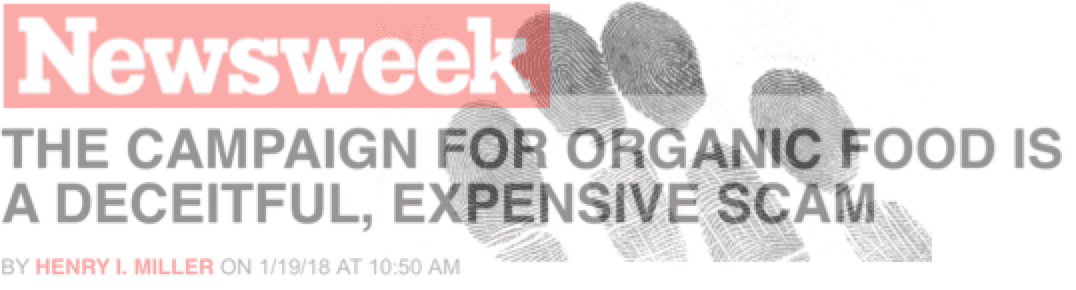
Monsanto’s Fingerprints All Over Newsweek’s Hit on Organic Food

(USRTK by Stacy Malkan) “The campaign for organic food is a deceitful, expensive scam,” according to a Jan. 19 Newsweek article authored by Dr. Henry I. Miller of the Hoover Institution.

If that name sounds familiar – Henry I. Miller – it may be because the New York Times recently revealed a scandal involving Miller: that he had been caught publishing an article ghostwritten by Monsanto under his own name in Forbes. The article, which largely mirrored a draft provided to him by Monsanto, attacked the scientists of the World Health Organization’s cancer panel (IARC) for their decision to list Monsanto’s top-selling chemical, glyphosate, as a probable human carcinogen.

Update: Newsweek’s bizarre response

Recommended: Sugar Leads to Depression – World’s First Trial Proves Gut and Brain are Linked (Protocol Included)

Reporting on an email exchange released in litigation with Monsanto over cancer concerns, the Times’Danny Hakim wrote:

“Monsanto asked Mr. Miller if he would be interested in writing an article on the topic, and he said, ‘I would be if I could start from a high-quality draft.’

The article appeared under Mr. Miller’s name, and with the assertion that ‘opinions expressed by Forbes Contributors are their own.’ The magazine did not mention any involvement by Monsanto in preparing the article …

Forbes removed the story from its website on Wednesday and said that it ended its relationship with Mr. Miller amid the revelations.”

The opinion wire Project Syndicate followed suit, after first adding a disclaimer to Miller’s commentaries noting that they would have been rejected if his collaboration with Monsanto had been known.

Desperate to Disparage Organic

The ghostwriting scandal has hardly slowed Miller down; he has continued to spin promotional content for the agrichemical industry from outlets such as Newsweek and The Wall Street Journal, without disclosing to readers his relationship with Monsanto.

Yet Miller’s Newsweek hit on organic food has Monsanto’s fingerprints in plain sight all over it.

For starters, Miller uses pesticide industry sources to make unsubstantiated (and ludicrous) claims about organic agriculture – for example, that organic farming is “actually more harmful to the environment” than conventional agriculture, or that organic allies spent $2.5 billion in a year campaigning against genetically engineered foods in North America.

Recommended: Detox Cheap and Easy Without Fasting – Recipes Included

The source on the latter inaccurate claim is Jay Byrne, a former director of corporate communications for Monsanto (not identified as such in the Newsweek article), who now directs a PR firm called v-Fluence Interactive.

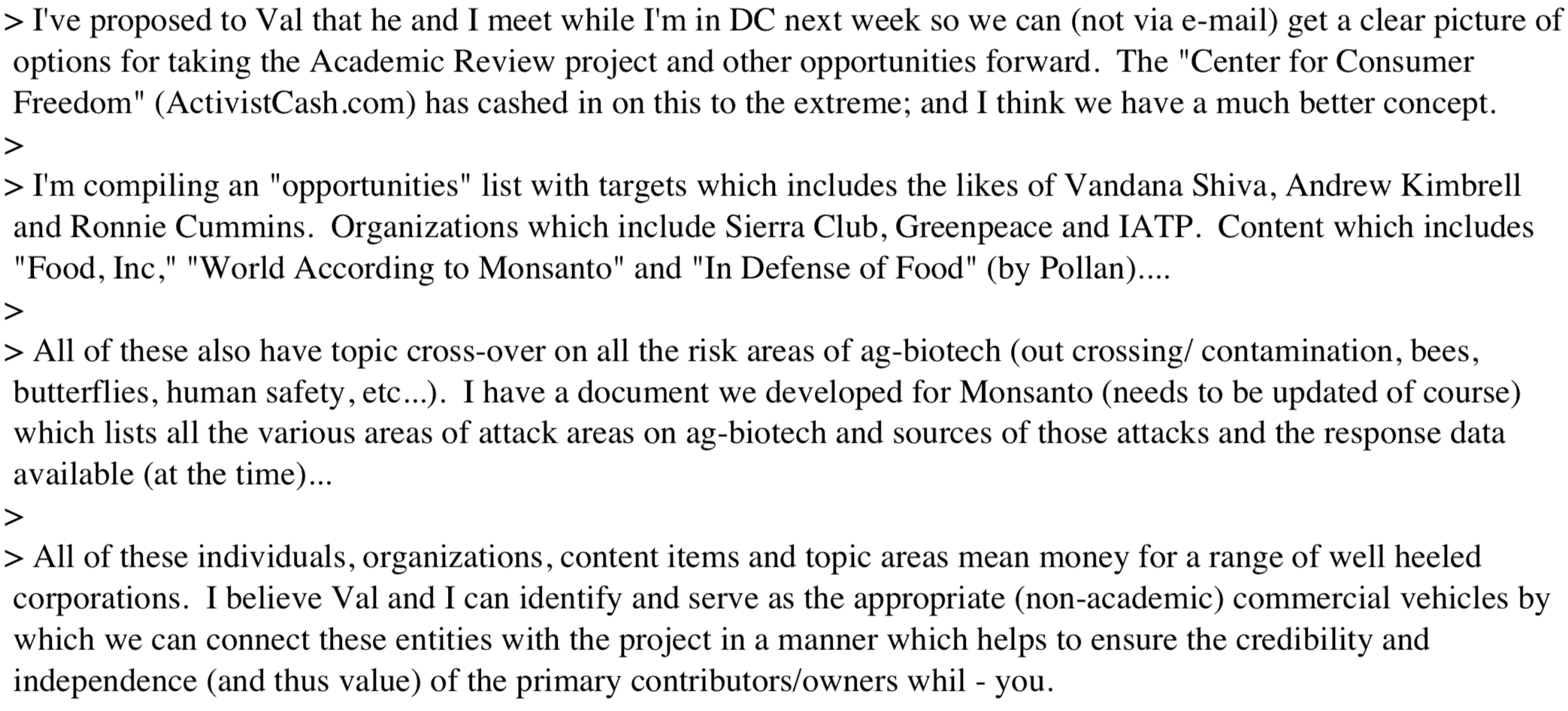
Email exchanges reveal how Monsanto works with people like Jay Byrne – and with Byrne specifically – to push exactly this type of attack against Monsanto’s foes while keeping corporate involvement a secret.

According to emails obtained by my group US Right to Know, Byrne played a key role in helping Monsanto set up a corporate front group called Academics Review that published a report attacking the organic industry as a marketing scam – the exact theme in Miller’s Newsweek article.

Recommended: How to Make the Healthiest Smoothies – 4 Recipes

Jay Byrne’s hit list of Monsanto foes. 

The concept of the front group – explained in the emails I reported here – was to create a credible-sounding platform from which academics could attack critics of the agrichemical industry while claiming to be independent, yet secretly receiving funds from industry groups. Wink, wink, ha, ha.

“The key will be keeping Monsanto in the background so as not to harm the credibility of the information,” wrote a Monsanto executive involved in the plan.

Byrne’s role, according to the emails, was to serve as a “commercial vehicle” to help obtain corporate funding. Byrne also said he was compiling an “opportunities” list of targets – critics of the agrichemical industry who could be “inoculated” from the academics’ platform.

Several people on Byrne’s “opportunities” hit list, or later attacked by Academics Review, were targets in Miller’s Newsweek article, too.

Miller’s Newsweek piece also tried to discredit the work of New York Times’ reporter Danny Hakim, without disclosing that it was Hakim who exposed Miller’s Monsanto ghostwriting scandal.

Recommended: Start Eating Like That and Start Eating Like This – Your Guide to Homeostasis Through Diet

As with other recent attacks on the organic industry, all fingers point back to the agrichemical corporations that will lose the most if consumer demand continues to rise for foods free of GMOs and pesticides.

Monsanto’s “Independent Academic” Ruse

Henry Miller has a long history of partnering with – and pitching his PR services to – corporations that need help convincing the public their products aren’t dangerous and don’t need to be regulated.

And Monsanto relies heavily on people with scientific credentials or neutral-sounding groups to make those arguments – people who are willing to communicate the company script while claiming to be independent actors. This fact has been established by reporting in the New York TimesLe MondeWBEZ, the Progressiveand many other outlets in recent years.

A newly released Monsanto document provides more details about how Monsanto’s propaganda and lobbying operation works, and the key role Henry Miller plays within it.

This 2015 “preparedness plan” – released by lawyers in the glyphosate cancer lawsuits – lays out Monsanto’s PR strategy to “orchestrate outcry” against the IARC cancer scientists for their report on glyphosate. The first external deliverable: “Engage Henry Miller.”

The plan goes on to name four tiers of “industry partners” – a dozen trade groups, academic groups and independent-seeming front groups such as the Genetic Literacy Project – that could help “inoculate” against the cancer report and “protect the reputation … of Roundup.”

Miller delivered for Monsanto with a March 2015 article in Forbes – the article later revealed as Monsanto’s writing – attacking the IARC scientists. The industry partners have been pushing the same arguments through various channels again and again, ever since, to try to discredit the cancer scientists.

Much of this criticism has appeared to the public as a spontaneous uprising of concern, with no mention of Monsanto’s role as the composer and conductor of the narrative: a classic corporate PR hoodwink.

Recommended: Holistic Guide to Healing the Endocrine System and Balancing Our Hormones

As more documents tumble into the public realm – via the Monsanto Papers and public records investigations – the “independent academic” ruse will become harder to maintain for industry surrogates like Henry I. Miller, and for media and policy makers to ignore.

For now, Newsweek is not backing down. Even after reviewing the documents that substantiate the facts in this article, Newsweek Opinion Editor Nicholas Wapshott wrote in an email, “I understand that you and Miller have a long history of dispute on this topic. He flatly denies your assertions.”

Neither Miller nor Wapshott have responded to further questions.

Stacy Malkan is co-director of the consumer watchdog and transparency group, US Right to Know. She is author of the book, “Not Just a Pretty Face: The Ugly Side of the Beauty Industry” (New Society, 2007). Disclosure: US Right to Know is funded in part by the Organic Consumers Association which is mentioned in Miller’s article and appears on Byrne’s hit list.